In academia, before you have a full time position you are often given the cautionary advice, "every talk is a job talk". This is often true, though not always in the short term.
Once you have a position, you are also told this, and "every talk is a funding pitch", i.e., to program officers, potential grant reviewers, etc.
There are other types of talks too. There are the "I might want to come to your university and am testing you out" talks, and also there are the, "We may want you to come to our university so are testing you out" talks. There are "tenure tour" talks, which is when TT professors travel to other universities to show off their steak knives and court letter writers. Sometimes this works in reverse, where junior faculty invite potential letter writers to their university to give talks.
Sometimes people give talks due to geographic convenience, or because they want to start a collaboration/friendship/etc with someone at that university.
I suppose sometimes a talk is just a talk, but I suspect that's the exception to the rule.
Showing posts with label politics. Show all posts
Showing posts with label politics. Show all posts
Friday, April 27, 2012
Tuesday, March 13, 2012
Vanity, Thy Name is Academic
As I navigate my way through the strange political maze of academia, I've been trying to categorize different personality types as I encounter them as a means for better understanding how to work with (near) them. I've decided if I can talk with someone and figure out what motivates them, I can better adjust myself to have a more positive conversation with them.
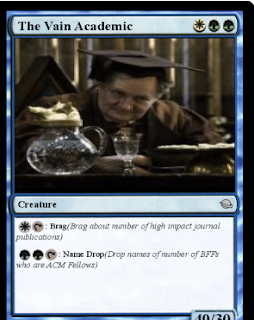
One personality type that can quickly be spotted is The Vain Academic. This is a person who boasts about their high impact publications, frequently drops names of their famous friends, and speaks disdainfully of others (particularly students). If you're familiar with Harry Potter, in my mind I usually think of this person as Professor Slughorn.
Sometimes, a vain person can be appeased with flattery and encouragement. You can quietly smile and nod your head at the right times, gently fanning their ego while occasionally making intelligent quips of your own so they still consider you a respectable peer. You do not dominate the conversation.
However, Vain Academics are people you need to tread carefully around, particularly as a junior person. Their egos are extremely fragile; much of their self-esteem is wrapped up in their accolades and connections. If they perceive any hint of false flattery or mocking behavior, the relationship will sour quickly. Furthermore, if you over-elevate them, they will then view you in a contemptuous way, which becomes difficult to recover from.
On the other hand, The Vain Academic also seeks approval from all, so even if you commit a gaffe (which you surely will), you can probably recover from it. Especially if you are a peer or superior, they will want you in their fan club.
Remember that old advice, "At dinner, you can judge a person by how they treat the waiter"? It's the same with academics; in particular, how they treat students. This is probably the biggest tip off.

One personality type that can quickly be spotted is The Vain Academic. This is a person who boasts about their high impact publications, frequently drops names of their famous friends, and speaks disdainfully of others (particularly students). If you're familiar with Harry Potter, in my mind I usually think of this person as Professor Slughorn.
Sometimes, a vain person can be appeased with flattery and encouragement. You can quietly smile and nod your head at the right times, gently fanning their ego while occasionally making intelligent quips of your own so they still consider you a respectable peer. You do not dominate the conversation.
However, Vain Academics are people you need to tread carefully around, particularly as a junior person. Their egos are extremely fragile; much of their self-esteem is wrapped up in their accolades and connections. If they perceive any hint of false flattery or mocking behavior, the relationship will sour quickly. Furthermore, if you over-elevate them, they will then view you in a contemptuous way, which becomes difficult to recover from.
On the other hand, The Vain Academic also seeks approval from all, so even if you commit a gaffe (which you surely will), you can probably recover from it. Especially if you are a peer or superior, they will want you in their fan club.
Remember that old advice, "At dinner, you can judge a person by how they treat the waiter"? It's the same with academics; in particular, how they treat students. This is probably the biggest tip off.

Wednesday, November 9, 2011
If politicians had to undergo an NSF review process...
Lately I've been hearing a lot of local election ads on the radio and television, and I find it fascinating how it's often acceptable for politicians to be exceptionally vague and hand-wavy in their rhetoric.
"Our town lost a lot of jobs last year. If you elect me, I will create more jobs! Vote for Bob Smith."
(How will you create more jobs? What is your methodology? Which sector will you create jobs in? Will you do the job creation, or will it be your staff? Where's your 4-year project plan?)
I think it's only fair. Given how harsh many of these politicians are on science funding, it should be reasonable to turn the tables.
"Our town lost a lot of jobs last year. If you elect me, I will create more jobs! Vote for Bob Smith."
(How will you create more jobs? What is your methodology? Which sector will you create jobs in? Will you do the job creation, or will it be your staff? Where's your 4-year project plan?)
I think it's only fair. Given how harsh many of these politicians are on science funding, it should be reasonable to turn the tables.
Tuesday, May 3, 2011
Birthers, Racism, and The Media
Here I was thinking, how I can I best write about what I think about the birthers? And then Tony Auth drew a fabulous editorial cartoon. Well done, Tony.
Also on the topic of birthers and latent racism, The New Black Woman posted a critique of how the media just played into Trump's hands, let him and other birthers spew all sorts of racist and xenophobic garbage unchecked, etc,:
Of course, then there's always the inevitable, "Oh noes! Our art will suffer by having to care about how we use language!" argument. You think I'm joking. If you watch the actual noose gaffe video, while fumbling Mitt Romney quips, 'You have to be careful what you say these days!' Aw. Not like the good old days where you could make noose jokes without a problem. Poor guy, he already has a lot on his plate, I shouldn't pick on him.
 |
| Image Descrption: Four panels. Upper left "He wasn't, you know, born in America." Upper right, "He's not, you know, A Christian." Bottom left, "He's you know, a Muslim or a Kenyan.". Bottom right, "He's well, you know..." [silhouette of Obama, visual implication is: '...black'] |
"...many of the traditional news outlets and journalists refused to examine the racial factor behind the birther issue. Big Media refused to dig deeper into the underlying racist feelings that when a black man or woman obtains higher power or authority, there's something astray about that person's ascent to power. It failed to ponder why so many people feel that whenever a black man or woman achieves great success, their rise to fame or fortune must be the result of either a law or being broken or skewed in their favor at the expense of a white person.I sincerely hope the media outlets take this as a challenge to make themselves uncomfortable and truly confront latent racism. The day they finally realize that their power is more than just selling toothpaste and viagra, and they can have a major hand in changing people's negative attitudes toward other races, cultures, and abilities. It doesn't have to be after school specials, just even the topics they choose to discuss and the way in which they discuss them. They could do so much better with not all that much effort.
But, I can't blame Big Media for failing to delve into any analytical reporting or investigating. Reporting on the racial, xenophobia aspect of the birther issue would require the media to confront the system of white supremacy and privilege set up to benefit many of the reporters working for Big Media. It would require them to dig deeper than the shallow reporting they are so accustomed to (due to advertising demands, a short attention span and hollow reasoning by their audience) and examine the subconscious racism laying dormant in a majority of our society. It would require making their audience and their bosses uncomfortable reading and editing stories about race as they would see quotes or segments reminiscent of their underlying racist feelings."
Of course, then there's always the inevitable, "Oh noes! Our art will suffer by having to care about how we use language!" argument. You think I'm joking. If you watch the actual noose gaffe video, while fumbling Mitt Romney quips, 'You have to be careful what you say these days!' Aw. Not like the good old days where you could make noose jokes without a problem. Poor guy, he already has a lot on his plate, I shouldn't pick on him.
Saturday, January 8, 2011
Another reason to diversify your publication venues - drama insurance
Recently I wrote about how to select a publication venue, and in the post suggested that it's good to have a "diverse portfolio" by aiming for a mix of top conferences, journals, and workshops that you publish in each year.
Another aspect I should have mentioned - it's also very good to diversify within each of these groups, in order to have drama insurance.
Whenever groups of humans get together to organize something, there is drama. And it's not always due to cantankerous individuals, I think it's somehow in our nature as human beings. I've seen it emerge in every organization I've ever participated in, from work projects to bake sales. It just happens, like rain.
As an author trying to get your name out there, you don't want to get caught in the crossfire of other people's drama. You just want to publish your paper. But as we've discussed before, a lot of getting your paper accepted at a top conference often has an element of random chance associated with it. For example, at many conferences, the majority of papers are "borderline", and it is up to the whim of your paper chair to decide whether or not to spend precious minutes discussing it. But this PC member likely has an agenda - perhaps s/he is involved in a posturing contest with another PC member. Perhaps there is some talk that too many papers from Podunk University have been accepted recently, and the PC member is afraid to advocate too strongly for your paper because Author #2 is affiliated with Podunk. And so on.
All of these goofy things happening that have absolutely nothing to do with your science!
An unbelievable amount of drama goes on underneath the hood of many conferences, and by diversifying you have extra insurance against this silliness. If Conference A gets caught up in a self-destructing snowball of doom, you still have Conferences B and C.
The best thing about Computer Science is we pretty much can work in any field. Physics. Music. Psychology. Astronomy. History. Architecture. Really, anything. So if your sub-field conference implodes, and your super-field conference implodes, branch out a bit. It's fun to solve problems in other disciplines, and in my experience they're always very glad to have you! Unless you're cantankerous.
Another aspect I should have mentioned - it's also very good to diversify within each of these groups, in order to have drama insurance.
Whenever groups of humans get together to organize something, there is drama. And it's not always due to cantankerous individuals, I think it's somehow in our nature as human beings. I've seen it emerge in every organization I've ever participated in, from work projects to bake sales. It just happens, like rain.
As an author trying to get your name out there, you don't want to get caught in the crossfire of other people's drama. You just want to publish your paper. But as we've discussed before, a lot of getting your paper accepted at a top conference often has an element of random chance associated with it. For example, at many conferences, the majority of papers are "borderline", and it is up to the whim of your paper chair to decide whether or not to spend precious minutes discussing it. But this PC member likely has an agenda - perhaps s/he is involved in a posturing contest with another PC member. Perhaps there is some talk that too many papers from Podunk University have been accepted recently, and the PC member is afraid to advocate too strongly for your paper because Author #2 is affiliated with Podunk. And so on.
All of these goofy things happening that have absolutely nothing to do with your science!
An unbelievable amount of drama goes on underneath the hood of many conferences, and by diversifying you have extra insurance against this silliness. If Conference A gets caught up in a self-destructing snowball of doom, you still have Conferences B and C.
The best thing about Computer Science is we pretty much can work in any field. Physics. Music. Psychology. Astronomy. History. Architecture. Really, anything. So if your sub-field conference implodes, and your super-field conference implodes, branch out a bit. It's fun to solve problems in other disciplines, and in my experience they're always very glad to have you! Unless you're cantankerous.
Monday, December 13, 2010
The Wikileaks Drama Continues
In recent news of this drama-riffic story, hackers have been attacking any organization or individual who has been deemed "unsupportive" of Wikileaks. This includes Swedish prosecutors, MasterCard, Visa, PayPal, and the Swiss Postal system. Largely these attacks have been ineffectual and meaningless, or, as one writer put it, "More like a cybermob than cyberwarfare".
As for the 1337 hackers, I have to say I'm not really following the call to arms. Because the scorecard as I see it is:
Frankly, I wish the black hats would actually come together to do some useful vigilanteism, like, say, help prevent child trafficking, or use computing tools to help find missing children. Assange just isn't worth it.
As for the 1337 hackers, I have to say I'm not really following the call to arms. Because the scorecard as I see it is:
- Someone stole raw data that was not theirs to steal. (Which, as the NY Times put it, "The Pentagon Papers this is not.")
- These data were leaked it to Julian Assange.
- Instead of caring about, well, anything, Assange acts like a megalomaniac drama queen pretending to be a journalist. So he dumps this raw data out on to the Internet. He encrypts some of it. Some of it he doesn't.
- The guvvies try to get their data back, but, well, we know how that worked out.
- Assange carries on the drama by saying, "boy-o-boy, watch out guvvies, touch me and I release the key to my insurance file!!111!!"
- And all the bozos on Slashdot and Digg and elsewhere keep up their battle cry of this ludicrous Save Assange! Hack the Planet! Swiper No Swiping!
Frankly, I wish the black hats would actually come together to do some useful vigilanteism, like, say, help prevent child trafficking, or use computing tools to help find missing children. Assange just isn't worth it.
Friday, December 3, 2010
The Leaky Cauldron
I've been grimly amused reading about the latest wleaks webhosting drama over the past few days because of the astounding lack of understanding of how distributed systems work displayed by both the media and lawmakers. Perhaps this is our fault as technologists, maybe we're not explaining things clearly enough.
I've decided to draw some pictures on virtual cocktail napkins to help.
This is (mostly) how servers and data flow on the internet used to work:
 One server, lots of nodes connect. Server distributing bad stuff? Shut it down, problem solved:
 But in today's world of peer-to-peer file sharing, we actually see a model that looks more like this:
 Not so happy about that file being shared? Well, you can try to stop it...
 ...but, well, good luck with that.
The cat is out of the bag, that file ain't never coming back. It's time to move on, folks.
I think it's hard for people to conceptualize decentralized networks. But it's really important to think about things this way, because this is what the internet is today. That first model is long, long gone.
I've decided to draw some pictures on virtual cocktail napkins to help.
This is (mostly) how servers and data flow on the internet used to work:


The cat is out of the bag, that file ain't never coming back. It's time to move on, folks.
I think it's hard for people to conceptualize decentralized networks. But it's really important to think about things this way, because this is what the internet is today. That first model is long, long gone.
Wednesday, November 24, 2010
You probably think this post is about you
One of the songs that always makes me laugh is Carly Simon's song, "You're So Vain." In case you're unfamiliar with the tune, the refrain goes something like this:
So I equally laughed when I saw this headline today: "Obama: 'I don't think about Sarah Palin'" Here's a snippet from the USA Today article:
You're so vainI always start giggling when the chorus starts. (Sometimes I even yell things at the radio.) I guess I find it funny because I tend to think about some things rather literally, thus this song just seems so silly because of course it's about whomever she is singing it to. Also, it's self-referential, which is just fun from a math standpoint.
You probably think this song is about you
You're so vain
I'll bet you think this song is about you
Don't you? Don't you?
So I equally laughed when I saw this headline today: "Obama: 'I don't think about Sarah Palin'" Here's a snippet from the USA Today article:
President Obama is refusing to take the bait on Sarah's Palin statement that she could beat him in the 2012 presidential race.This reminds me of the Carly Simon song.
ABC's Barbara Walters tried to get a rise out of Obama on Palin and 2012, but the president said: "I don't speculate on what's going to happen two years from now."
Pressed by Walters, Obama said: "What I'm saying is I don't think about Sarah Palin."
Tuesday, November 23, 2010
TSA Awareness FAIL
 First there were the women who had their vaginas groped. (Including a rape survivor). Then there was the woman who had breast cancer who was rudely asked to remove her prosthetic breast. And now, there is a person who had bladder cancer (and an urostomy bag) who was treated rudely when he requested privacy pat-down, would not be listened to when he tried to explain his condition and how his urostomy bag worked ("don't break the seal"), had to sit for hours in his own urine because TSA was too stupid to follow directions.
I am outraged. I cannot tell you how outraged I am. This is stupid, useless, and ridiculous. TSA screeners, get a freaking clue and start treating people as HUMAN BEINGS, not terrorists. Think RESPECT not SUSPECT.
PS: Also, at re-education camp, I highly suggest you enroll in a class on probability and statistics. You need some serious help with sampling.
Monday, October 11, 2010
And the Truthy Shall Set You Free
I've just read about a great project at Indiana called Truthy. (Here's a linky). The idea is simple: during the upcoming election, their system will detect smear campaigns on social networking sites in real time, and post some visualization of how the meme spreads over time. The idea is to try to prevent "astroturfing", which are well-organized political campaigns masquerading as grassroots efforts.
"The team will then generate diffusion network images that visitors to Truthy.indiana.edu can view as groups of nodes and edges that identify retweets, mentions, and the extent of the epidemic...

Menczer got the idea for the Truthy website after hearing researchers from Wellesley College speak earlier this year on their research analyzing a well-known Twitter bomb campaign conducted by the conservative group American Future Fund (AFF) against Martha Coakley, a democrat who lost the Massachusetts senatorial seat formerly held by the late Edward Kennedy. Republican challenger Scott Brown won the seat after AFF set up nine Twitter accounts in early morning hours prior to the election and then sent out 929 tweets in two hours before Twitter realized the information was spam. By then the messages had reached 60,000 people.Definitely a clever approach to the problem, and if you're a twitter user, get involved!
Menczer explained that because search engines now include Twitter trends in search results, an astroturfing campaign -- where the concerted efforts of special interests are disguised as a spontaneous grassroots movement -- that includes Twitter bombs can jack up how high a result shows up on Google even if the information is false...
'One of the concerns about social media is that people are being manipulated without realizing it because a meme can be given instant global popularity by a high search engine ranking, in turn perpetuating the falsehood,' Menczer said."
Subscribe to:
Posts (Atom)