Recently I met someone who just started a faculty job fresh out of grad school, about 5 months ago. Sheepishly they said to me, "So, uh... how did you find your first year?"
Gleefully I replied, "It was terrible! But don't worry, it's terrible for everyone, then it gets really good."
The truth of the matter is this - until you have a solid group of trained PhD students, some grant money, and have taught a class more than once, the job feels incredibly stressful. All the constant demands on your time, and the constant rejection - grant rejections, paper rejections, low teaching evaluations, makes you wonder if you can possibly stand another day.
Honestly, in my first year, I wandered around muttering to myself the Peace Corps mantra, "The toughest job I'll ever love, the toughest job I'll ever love". At work I worked, and at home I watched an insane amount of mind-numbing television. I had family members ask me why I was doing this, and if it was worth all the work. Truthfully, I contemplated alternate careers. I remember saying once to my husband, "Wouldn't it be nice to be a barista? They don't need to worry about budgets, or teaching evaluations, or annual reviews. They just make coffee. I can totally do that! I practically earned a PhD in coffee during grad school!"
But then I received funding, and I was over the moon. My students blossomed into fine researchers, and began hitting home runs in their publications. I started teaching the same courses again, and my prep time became nothing.
I can't claim everything is easy, of course, but I can say beyond a shadow of a doubt that anything is better than that first year, and it does indeed get better.
Showing posts with label academia. Show all posts
Showing posts with label academia. Show all posts
Wednesday, February 6, 2013
Thursday, December 13, 2012
Acceptance Rates and Impact Factors
For those of you who do publish at computer science conferences*:
1) On your CV/Biosketch/Website/etc. list-of-publications, do you include conference acceptance rates?
2) If you do, what is the threshold for you to mention it? (e.g., 50%, 30%, 10% ?)
For those of you who don't publish at computer science conferences:
0) Hey, why aren't you publishing at CS conferences? We're cool people, and we start counting at zero.
1) On your CV/Biosketch/Website/etc. list-of-publications, do you include journal impact factors?
2) If you do, what is the threshold for you to mention it? (e.g., do you list IFs for startup journals)?
And for anyone willing to share their field / subfield, I'd be interested to hear that as well. I'm planning to assemble this information into a longer post on the topic in a few weeks.
---
* This includes anything which has archival proceedings, like some workshops, symposia, summer/winter/fall/spring schools, etc.
1) On your CV/Biosketch/Website/etc. list-of-publications, do you include conference acceptance rates?
2) If you do, what is the threshold for you to mention it? (e.g., 50%, 30%, 10% ?)
For those of you who don't publish at computer science conferences:
0) Hey, why aren't you publishing at CS conferences? We're cool people, and we start counting at zero.
1) On your CV/Biosketch/Website/etc. list-of-publications, do you include journal impact factors?
2) If you do, what is the threshold for you to mention it? (e.g., do you list IFs for startup journals)?
And for anyone willing to share their field / subfield, I'd be interested to hear that as well. I'm planning to assemble this information into a longer post on the topic in a few weeks.
---
* This includes anything which has archival proceedings, like some workshops, symposia, summer/winter/fall/spring schools, etc.

Friday, November 16, 2012
Seeing sexism in academia - moving up the ranks opens the eyes
A few years ago I remember reading an article about the fact that as women become more senior in their disciplines they start to encounter more sexism. For a long time I've been trying to figure out how that worked - was it that senior women encountered senior men more often, and were thus encountering old attitudes?
Recently, after a particularly upsetting incident, I realised what it is. It is that as we become more senior and have more experiences, we simply see sexism more. We are more aware. As junior women, when we encounter a microaggressive comment, it's just one papercut. Maybe it's one of those very subtle papercuts that you don't even notice until a few days later when you use rubbing alcohol.
But as you become more senior, you become more aware. You start counting these comments, and noticing them more and more.
"What's the big deal? Who cares what they say?" the well-intentioned male colleague says. The big deal is that at work I am Scientist first, Woman second. Men that treat my science as secondary (or even peripherally) to my gender insult my intelligence and insult my years of hard work to get to the place I am at.
Furthermore, the fact that these comments are unequally delivered is particularly infuriating. If, when my male colleagues had newborns, people said, "OMG! How will you survive as a professor??? How will you keep your research program afloat?! AUGH!!!", it would be ok. If, when my male colleagues wore colorful clothing, their senior colleagues stopped them in the hallway and said, "Please don't take this in the wrong way, but that shirt really brings out the color of your beautiful eyes.", it would be ok.
But it's not equal. Women-as-mother, women-as-sexulized-object - these take first place. Women-as-scholar, woman-as-professor is in the back seat.
So what do I do in these situations when they happen to me? First, my heart starts pounding. I think, "This is A Moment! I am supposed to Say Something!" Then, I stop. I realize this person is just clueless. They have no idea that they are saying all this dreadful stuff only to women and not men. They honestly have no earthly idea. Finally, I ask myself if this is a Teaching Moment or not. It usually is not, at least not right then.
These attitudes are so ingrained in our culture, they are just a part of how many people think. Publically humiliating the offender will not suddenly make them change their ways. But sometimes I desperately want to.
Recently, after a particularly upsetting incident, I realised what it is. It is that as we become more senior and have more experiences, we simply see sexism more. We are more aware. As junior women, when we encounter a microaggressive comment, it's just one papercut. Maybe it's one of those very subtle papercuts that you don't even notice until a few days later when you use rubbing alcohol.
But as you become more senior, you become more aware. You start counting these comments, and noticing them more and more.
"What's the big deal? Who cares what they say?" the well-intentioned male colleague says. The big deal is that at work I am Scientist first, Woman second. Men that treat my science as secondary (or even peripherally) to my gender insult my intelligence and insult my years of hard work to get to the place I am at.
Furthermore, the fact that these comments are unequally delivered is particularly infuriating. If, when my male colleagues had newborns, people said, "OMG! How will you survive as a professor??? How will you keep your research program afloat?! AUGH!!!", it would be ok. If, when my male colleagues wore colorful clothing, their senior colleagues stopped them in the hallway and said, "Please don't take this in the wrong way, but that shirt really brings out the color of your beautiful eyes.", it would be ok.
But it's not equal. Women-as-mother, women-as-sexulized-object - these take first place. Women-as-scholar, woman-as-professor is in the back seat.
So what do I do in these situations when they happen to me? First, my heart starts pounding. I think, "This is A Moment! I am supposed to Say Something!" Then, I stop. I realize this person is just clueless. They have no idea that they are saying all this dreadful stuff only to women and not men. They honestly have no earthly idea. Finally, I ask myself if this is a Teaching Moment or not. It usually is not, at least not right then.
These attitudes are so ingrained in our culture, they are just a part of how many people think. Publically humiliating the offender will not suddenly make them change their ways. But sometimes I desperately want to.
Wednesday, August 29, 2012
My how things change
Before you are a professor:
My dear professors of yesteryear, I am sorry for judging. I get it now.
"OMG, I cannot believe the professor's slides have typos in them. And a boring PPT template. And looks like it was written in 1983. Oh, and, like, OMG, don't they know we don't use gopher anymore??"After you are a professor:
Hmm... will they notice the mustard stain?Yeah. It's that bad, folks. I have typos! Spelling errors! Ugly slides that are from 1983! And despite my best efforts, large parts of my lectures are BORING!
My dear professors of yesteryear, I am sorry for judging. I get it now.
Tuesday, July 31, 2012
Houston, we have an image problem
I was at a novelty store a few months ago, and came across a board game called "The Mad Professor Science Kit". I noted that the mad science professor looks nothing like me at all.


I've written a lot about how journalists and artists and other media people need to get the memo about what professors and scientists look like, in order to help change images in the minds of the younger generation.
Alas, we still have a ways to go. Here is my unscientific analysis.
Method: Clip Art Google Image search, Screenshot of page 1 of results.
Term 1: professor

Results: 8% owl, 92% male, 0% female. Only one person who may be of asian or latino descent. (Note: Page 2 has a whopping two female professors - wowie! And one person of color.)
Term 2: scientist

Results: 80% male, 20% female. No owls. One person of color. Page two has owls, and a few more women.
Term 3: engineer

Results: Of 19 humans and gendered characters (Mickey Mouse), 90% male, 10% female. No people of color.
Term 4: "computer scientist"

Results: Of the three humans, 33% are women! And it's Grace Hopper, baby! No people of color, though we do have a link to "African Americans in Science and Technology", which is nice. An a Pi symbol, cat, Connect 4, and some cool geek pride T-shirts.
"Software engineer" and "programmer" do not yield very positive results, but I am pleased to say "computer programmer" yields several women, including a woman of color and this awesome coloring book page:

I know it seems like a silly thing, clipart, but a heck of a lot of people use it when preparing presentations.
Any artists out there want to start a revolution? Or maybe work on an NSF proposal? I think this would be a great STEM education thing. And easy as anything to do.
Any artists out there want to start a revolution? Or maybe work on an NSF proposal? I think this would be a great STEM education thing. And easy as anything to do.
Monday, May 28, 2012
Advice to people submitting things for review
Dear Author(s):
Generally, when editors/PC members volunteer hours of their time to read your paper, read reviews of your paper, and give you helpful comments to improve your work, you should be polite, kind, and thankful toward them. That way, if your paper is borderline, we are far more likely to cut you a break.
If you are a big jerk, and your science is suspect, there is little hope for you.
No-love,I am always shocked when authors say, "I am brilliant, u r dumb" to people in a position of power over the fate of their paper / grant. As if that will really help their case.
FCS
Now, there are certainly cases where reviewers are wrong, or they ask something that's well outside of scope of a minor revision. But this is the exception, not the rule.
I am reaching the conclusion that "be a good citizen in the scientific community" classes might be beneficial during new student indoctrination. (Along with some sort of professional writing course that includes a unit entitled "'Yo Professor!' and Other Letter Writing Atrocities.")
Friday, April 27, 2012
When a talk is just a talk
In academia, before you have a full time position you are often given the cautionary advice, "every talk is a job talk". This is often true, though not always in the short term.
Once you have a position, you are also told this, and "every talk is a funding pitch", i.e., to program officers, potential grant reviewers, etc.
There are other types of talks too. There are the "I might want to come to your university and am testing you out" talks, and also there are the, "We may want you to come to our university so are testing you out" talks. There are "tenure tour" talks, which is when TT professors travel to other universities to show off their steak knives and court letter writers. Sometimes this works in reverse, where junior faculty invite potential letter writers to their university to give talks.
Sometimes people give talks due to geographic convenience, or because they want to start a collaboration/friendship/etc with someone at that university.
I suppose sometimes a talk is just a talk, but I suspect that's the exception to the rule.
Once you have a position, you are also told this, and "every talk is a funding pitch", i.e., to program officers, potential grant reviewers, etc.
There are other types of talks too. There are the "I might want to come to your university and am testing you out" talks, and also there are the, "We may want you to come to our university so are testing you out" talks. There are "tenure tour" talks, which is when TT professors travel to other universities to show off their steak knives and court letter writers. Sometimes this works in reverse, where junior faculty invite potential letter writers to their university to give talks.
Sometimes people give talks due to geographic convenience, or because they want to start a collaboration/friendship/etc with someone at that university.
I suppose sometimes a talk is just a talk, but I suspect that's the exception to the rule.
Tuesday, March 13, 2012
Vanity, Thy Name is Academic
As I navigate my way through the strange political maze of academia, I've been trying to categorize different personality types as I encounter them as a means for better understanding how to work with (near) them. I've decided if I can talk with someone and figure out what motivates them, I can better adjust myself to have a more positive conversation with them.
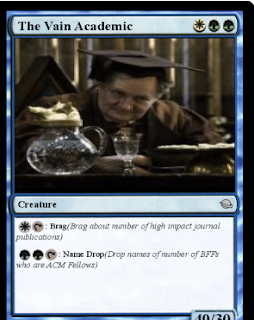
One personality type that can quickly be spotted is The Vain Academic. This is a person who boasts about their high impact publications, frequently drops names of their famous friends, and speaks disdainfully of others (particularly students). If you're familiar with Harry Potter, in my mind I usually think of this person as Professor Slughorn.
Sometimes, a vain person can be appeased with flattery and encouragement. You can quietly smile and nod your head at the right times, gently fanning their ego while occasionally making intelligent quips of your own so they still consider you a respectable peer. You do not dominate the conversation.
However, Vain Academics are people you need to tread carefully around, particularly as a junior person. Their egos are extremely fragile; much of their self-esteem is wrapped up in their accolades and connections. If they perceive any hint of false flattery or mocking behavior, the relationship will sour quickly. Furthermore, if you over-elevate them, they will then view you in a contemptuous way, which becomes difficult to recover from.
On the other hand, The Vain Academic also seeks approval from all, so even if you commit a gaffe (which you surely will), you can probably recover from it. Especially if you are a peer or superior, they will want you in their fan club.
Remember that old advice, "At dinner, you can judge a person by how they treat the waiter"? It's the same with academics; in particular, how they treat students. This is probably the biggest tip off.

One personality type that can quickly be spotted is The Vain Academic. This is a person who boasts about their high impact publications, frequently drops names of their famous friends, and speaks disdainfully of others (particularly students). If you're familiar with Harry Potter, in my mind I usually think of this person as Professor Slughorn.
Sometimes, a vain person can be appeased with flattery and encouragement. You can quietly smile and nod your head at the right times, gently fanning their ego while occasionally making intelligent quips of your own so they still consider you a respectable peer. You do not dominate the conversation.
However, Vain Academics are people you need to tread carefully around, particularly as a junior person. Their egos are extremely fragile; much of their self-esteem is wrapped up in their accolades and connections. If they perceive any hint of false flattery or mocking behavior, the relationship will sour quickly. Furthermore, if you over-elevate them, they will then view you in a contemptuous way, which becomes difficult to recover from.
On the other hand, The Vain Academic also seeks approval from all, so even if you commit a gaffe (which you surely will), you can probably recover from it. Especially if you are a peer or superior, they will want you in their fan club.
Remember that old advice, "At dinner, you can judge a person by how they treat the waiter"? It's the same with academics; in particular, how they treat students. This is probably the biggest tip off.
Monday, February 27, 2012
Today was a a ____ day to be a professor
At the end of every day, I make a statement like, "Today was a good day to be a professor", or, "Today was a bad day to be a professor". (And some days are partly cloudy.)
It's interesting to reflect upon which activities bring me the most joy, and which are the most frustrating. So, let's see:
Favorite thing: Meeting with my RAs. They are just good kids. They are sweet, fun, and brilliant. I love sitting around and bouncing ideas around with them and solving problems together. They impress the heck out of me with all they've accomplished thus far.
Least favorite thing: Drama and politics. Every sphere of this job involves some of each. For drama, I process it on a case by case basis, and try to be as fair and understanding as I can.
For politics, I am usually completely clueless. Sometimes I'll talk to someone, and hours later realize there were hidden subtexts beyond my ability to comprehend and quickly respond to in the moment. I'm not sure if I'm poorly socialized, aloof, or both, but frankly a lot of the politics surrounding this job positively baffle me.
Unfortunately being successful as a professor seems to require political savviness, in a way very different than in industry. I felt like in industry the rules were clearer; perhaps because everyone was working toward the same goal (e.g., please the customer). Academia is more like a collection of small empires. We all have shared goals of Furthering Education and Advancing Knowledge, but go about them in very different ways. We have frequent encounters with other Dukes, where we must broadcast our land's contribution to the Kingdom at every turn.
Post the PhD level, anyone with motivation and drive can learn to prep and teach a class, acquire external funding, effectively manage a research group, and publish lots of papers in good places. Political savviness, however, is another beast entirely.
It's interesting to reflect upon which activities bring me the most joy, and which are the most frustrating. So, let's see:
Favorite thing: Meeting with my RAs. They are just good kids. They are sweet, fun, and brilliant. I love sitting around and bouncing ideas around with them and solving problems together. They impress the heck out of me with all they've accomplished thus far.
Least favorite thing: Drama and politics. Every sphere of this job involves some of each. For drama, I process it on a case by case basis, and try to be as fair and understanding as I can.
For politics, I am usually completely clueless. Sometimes I'll talk to someone, and hours later realize there were hidden subtexts beyond my ability to comprehend and quickly respond to in the moment. I'm not sure if I'm poorly socialized, aloof, or both, but frankly a lot of the politics surrounding this job positively baffle me.
Unfortunately being successful as a professor seems to require political savviness, in a way very different than in industry. I felt like in industry the rules were clearer; perhaps because everyone was working toward the same goal (e.g., please the customer). Academia is more like a collection of small empires. We all have shared goals of Furthering Education and Advancing Knowledge, but go about them in very different ways. We have frequent encounters with other Dukes, where we must broadcast our land's contribution to the Kingdom at every turn.
Post the PhD level, anyone with motivation and drive can learn to prep and teach a class, acquire external funding, effectively manage a research group, and publish lots of papers in good places. Political savviness, however, is another beast entirely.
Tuesday, February 14, 2012
Achoo! Work life balance is a myth.
I am allergic to conversations on work life balance. Basically, they make me feel uncomfortable and guilty, which make my eyes red and itchy. (And allegra doesn't seem to make the deadlines go away...)
So I was happy to see this article in Fast Company by Craig Chappelow, "Work/Life balance is a myth; here's what you can do about it." There was no real news in the article, but I liked this a lot:
In personal life, things are usually calm, peaceful, and somewhat boring with occasional intense, dramatic moments. Some of these dramatic moments are quick and minor (flat tire, broken furnace, lost filling, puking child), some of these moments are lengthy and painful (health decline / death of family members, financial worries, etc).
It is not possible to predict when dramatic moments will occur in real life, and it's only a little bit possible to predict when fires will happen in professional life. So I tend to agree that having work life balance is a bit of a myth.
So I was happy to see this article in Fast Company by Craig Chappelow, "Work/Life balance is a myth; here's what you can do about it." There was no real news in the article, but I liked this a lot:
Here’s what I tell [executives]: work-life balance is a myth. That myth compels many of us to view an ideal life as a set of perfectly level scales. On the tray on one side is your personal life. On the other side is your work life. With heroic efforts, you can keep both trays exactly level. If one starts to tip too far, you make some kind of nifty move that balances them again.In professional life (both academically and previously in industry), I tend to find it's feast or famine. There are times when everything is going nuts, and there are times when things are calm, peaceful, and somewhat boring.
In reality, that perfect balance almost never occurs, except for those rare, fleeting moments when the trays pass each other on the way up or down--and we’re too frazzled to appreciate that brief moment of self-actualization anyway.
In personal life, things are usually calm, peaceful, and somewhat boring with occasional intense, dramatic moments. Some of these dramatic moments are quick and minor (flat tire, broken furnace, lost filling, puking child), some of these moments are lengthy and painful (health decline / death of family members, financial worries, etc).
It is not possible to predict when dramatic moments will occur in real life, and it's only a little bit possible to predict when fires will happen in professional life. So I tend to agree that having work life balance is a bit of a myth.
Monday, January 30, 2012
My student is so good you can't have them
It's been positively fascinating reading recommendation letters for prospective graduate students. The majority are fairly normal, but a few are kind of clingy.
While it's true good students are hard to find, and showing some level of adoration and commitment toward them is a good idea, clinging too tightly is bad practice professionally and managerially. And in fact, I've heard some stories of clingy advisors that cross me as borderline abusive.
Maybe in other fields this sort of thing is tolerable, but a graduate student in CS, even a bad one, can get a job anywhere, and make 5 times as much as they would as a PhD student. So it doesn't cross me as particularly clever to treat them poorly.
"Ms. Hopper is awesome and will do great at your university, except I really don't want her to go there, I want her to stay with meeeeeeeee."Sometimes, the clingy professors will trash the student too, sort of like in the way I tell people, "this chocolate cake is TERRIBLE, you definitely don't want any."
While it's true good students are hard to find, and showing some level of adoration and commitment toward them is a good idea, clinging too tightly is bad practice professionally and managerially. And in fact, I've heard some stories of clingy advisors that cross me as borderline abusive.
Maybe in other fields this sort of thing is tolerable, but a graduate student in CS, even a bad one, can get a job anywhere, and make 5 times as much as they would as a PhD student. So it doesn't cross me as particularly clever to treat them poorly.
Tuesday, January 24, 2012
Paper top 40 predictions
I've decided I am absolutely terrible at predicting which papers will be "a hit" and which papers will never get cited or read.
Like most academics, I'm usually working on several papers at the same time. In my mind as we're preparing and submitting, I often place bets on how the reviews will come back. Formulating my prediction involves not only the content of the paper, but also the publication venue, who I expect the reviewers might be, and other misc. variables.
I'm nearly always wrong.
And post-publication, the papers I am most proud of are never cited. The papers I am most ashamed of are frequently cited. I am considering employing reverse psychology as I write.
Either that or switch into mobile computing. Those people are so connected every paper has a gazillion citations.
Like most academics, I'm usually working on several papers at the same time. In my mind as we're preparing and submitting, I often place bets on how the reviews will come back. Formulating my prediction involves not only the content of the paper, but also the publication venue, who I expect the reviewers might be, and other misc. variables.
I'm nearly always wrong.
And post-publication, the papers I am most proud of are never cited. The papers I am most ashamed of are frequently cited. I am considering employing reverse psychology as I write.
Either that or switch into mobile computing. Those people are so connected every paper has a gazillion citations.
Monday, January 16, 2012
More thoughts on unsolicited professorial advice
One other thing you get a lot of advice about as a new professor is how to run your show.
"Don't spend too much time on teaching"
"Write every day"
"Don't take too many grad students your first year"
The thing is, like anything, do what works for you. You want to spend 14 hours on making Teh Perfect Slides for your first class, do it. You want to get up at 4am and start writing, go for it. Want to relax all weekend playing Facebook games while occasionally picking at your grant proposal, sounds grand!
The trick is to know what makes you happy and know your own style, and work that way. You have a lot of flexibility in your schedule, the trick is figuring out how to best structure it so you're most productive. And to factor in recharging time, for whatever that means for you.
"Don't spend too much time on teaching"
"Write every day"
"Don't take too many grad students your first year"
The thing is, like anything, do what works for you. You want to spend 14 hours on making Teh Perfect Slides for your first class, do it. You want to get up at 4am and start writing, go for it. Want to relax all weekend playing Facebook games while occasionally picking at your grant proposal, sounds grand!
The trick is to know what makes you happy and know your own style, and work that way. You have a lot of flexibility in your schedule, the trick is figuring out how to best structure it so you're most productive. And to factor in recharging time, for whatever that means for you.
Thursday, January 5, 2012
Fun with Google
You know that game where you type something into Google and note its wacky suggestions? I have no idea why, but I tried it today with 'Professors are'. This is the result:


So it would appear I am a candy bar, overpaid, and super-mean. Excellent! Ready for the Spring semester to start.
I also tried 'Computer Scientists are', and this is the result:

I suppose 3/4 ain't bad (I kind of like the blank one...)
Tuesday, December 20, 2011
NRC Computer Science Rankings Reprise
There's an article in CACM this month by Computer Scientists Andrew Bernat and Eric Grimson, Doctoral Program Rankings for U.S. Computing Programs: The National Research Council Strikes Out. It talks about the ways in which NRC rankings are broken for CS (we have heard this before), but it details ways in which it could be fixed, which we hadn't heard before, and I like.
Two suggestions I thought were good:
Two suggestions I thought were good:
- "Explore making the rankings subdiscipline-dependent. It is clear that different departments have different strengths. Thus, enabling a finer-grained assessment would allow a department with strength in a sub-field, but perhaps not the same across-the-board strength, to gain appropriate visibility. This may be particularly valuable for students deciding where to apply."
- "Use data mining to generate scholarly productivity data to replace commercially collected citation data that is incomplete and expensive."
The first is a nice idea; for example, you might be interested in a top ranked department, but it turns out 19/20 faculty focus on Theory and you actually want to do Systems. Or there might be some school with three top faculty exactly in your subspecialty, but you don't see them because they're 93rd in the rankings.
The second is nice as well; I think with Google Scholar Citations data available this turns out to be a trivially easy problem to solve.
Maybe CRA can do their own rankings; they collect a lot of their own data anyway, and it avoids needing to rely on the NRC.
Monday, December 12, 2011
New adventures in publishing metrics
In case you haven't heard, Google Scholar Citations recently opened its doors, allowing academics to set up Google Scholar profiles, track their citations, h-index and i10-index, and see pretty graphs.
At first I thought: Yay! Especially since, for Computer Science, this was right on the heels of Cite Scholar's beta release, which is all about highlighting the fact that in CS we're all about the top tier conferences and journals don't matter much for us.
Then I thought: Boo! Now it's easier for the bean counters to count beans. Also, I sense there's this "who's searched for me" button coming, which creeps me out. This is actually why I don't ever click on academia.edu pages.
After a few weeks of reflection I am still on the fence. While I can't speak for other fields, in CS number of citations doesn't necessarily mean anything about quality or impact of work. I can think of several lackluster papers that have hundreds of citations, whereas others are incredible and barely hardly any. Also, sometimes an insane number of citations simply means youforced encouraged people to cite you by releasing some software or data.
On the other hand, I find these new graphs seem to ignite my "MUST WRITE MORE" instinct, just as the darling tune my new washing machine plays encourages me to do more laundry.
At first I thought: Yay! Especially since, for Computer Science, this was right on the heels of Cite Scholar's beta release, which is all about highlighting the fact that in CS we're all about the top tier conferences and journals don't matter much for us.
Then I thought: Boo! Now it's easier for the bean counters to count beans. Also, I sense there's this "who's searched for me" button coming, which creeps me out. This is actually why I don't ever click on academia.edu pages.
After a few weeks of reflection I am still on the fence. While I can't speak for other fields, in CS number of citations doesn't necessarily mean anything about quality or impact of work. I can think of several lackluster papers that have hundreds of citations, whereas others are incredible and barely hardly any. Also, sometimes an insane number of citations simply means you
On the other hand, I find these new graphs seem to ignite my "MUST WRITE MORE" instinct, just as the darling tune my new washing machine plays encourages me to do more laundry.
Tuesday, December 6, 2011
Unsolicited Advice, While Pregnant or Professor
When I was pregnant, a ton of random people used to come up to me at the grocery store, movie theater, walmart - everywhere - giving me unsolicited advice. It was like I was wearing a sign. A few times it was a birth horror story of someone they knew, sometimes it was asking me if I was having twins, and once it was a waitress telling me to not drink decaf coffee because it would give my unborn child pink eye. (I wish I were joking).
All of my friends seem to have experienced this bizarre phenomenon as well, so I guess there must be some sort of Protect The Children collective group thing going on.
In any case, I find this strange phenomenon happening again as a new professor. I get unsolicited advice early and often from others. It's often pre-packaged tidbits, like, "Teaching is like a gas - it consumes all space available". Sometimes it's strange things, like the more senior assistant professor who put a hand on my arm, looks me in the eye and says, "It gets better." (like I was grieving the death of a loved one).
I know this is all well intentioned, but sometimes when I get unsolicited professorial advice I desperately want to say back, "YES. I AM HAVING TWINS.", just to see the look on their face.
All of my friends seem to have experienced this bizarre phenomenon as well, so I guess there must be some sort of Protect The Children collective group thing going on.
In any case, I find this strange phenomenon happening again as a new professor. I get unsolicited advice early and often from others. It's often pre-packaged tidbits, like, "Teaching is like a gas - it consumes all space available". Sometimes it's strange things, like the more senior assistant professor who put a hand on my arm, looks me in the eye and says, "It gets better." (like I was grieving the death of a loved one).
I know this is all well intentioned, but sometimes when I get unsolicited professorial advice I desperately want to say back, "YES. I AM HAVING TWINS.", just to see the look on their face.
Thursday, November 17, 2011
Signal Boost: Stand With Science
Junior PI Scientist-Mom-Wife wrote to ask me to signal boost Stand With Science, and I am more than happy to oblige. I'm actually going to repost her words here, to tell you about this effort.
Readers, please sign this letter. Bloggers, please blog about this. Make some noise. The last thing we want to do in this economy is cut STEM research funding - let's send a strong message to Congress.
Next week the Congress Joint Select 'super' Committee on Deficit Reduction will decide where to make the next big cuts. If they do not agree or find a plan to reduce spending, sweeping cuts will be put into effect that will likely affect everyone in science and academia.Here's the video:
A group of MIT students have started a letter urging Congress not to cut science funding and they are amassing signatures. They include an amazing video that describes the importance of science, engineering and technology to our daily lives and to American jobs. It's a positive message, and really accessible to the public.
There are now about 7000 signatories on this letter, including Nobel Prize winners and numerous well known scientists (you can view signatories Bob Horvitz #6854, Philip Sharp #6866, Bob Weinberg #6846, Susan Lindquist #6727, Doug Melton #6994, Ray MacDonald#3652, Gary Ruvkun #3712, Didier Stainier #4064, Richard Hynes, Luisa Iruela-Arispe #5087, Andrew Ewald #6899, etc...) and the number keeps growing.
The video and petition have clearly gone viral, which is great. The main message is that the future of science is at stake.
This video and letter have been covered by the NY Times, Science (AAAS) and many other news organizations and blogs. We need faculty and respected scientists to help further this worthy request to Congress.
If you have time, please view the MIT student video and consider signing the letter.
Readers, please sign this letter. Bloggers, please blog about this. Make some noise. The last thing we want to do in this economy is cut STEM research funding - let's send a strong message to Congress.
Monday, October 17, 2011
Advice for new professors
A summary of advice I have for new professors.*
1) Delegate
Graduate students were invented for a reason. Delegate everything. Data analysis. Literature reviews. Writing. Teaching prep. If you don't have any graduate students, find some undergrads. A task you might find mundane can actually be "research experience".
One of my colleagues laments that their students often mess things up, causing even more work than just doing it themselves. For some things this may be true, but thus far I've been pleasantly surprised with what happens when I challenge my students. Even if they don't do a perfect job they are still doing useful work for both of us.
For CS-type folks -- get someone else to manage your machines. I know it's tempting to spend hours and hours tweaking your linux box to play fur elise backwards every other Tuesday at 2:22pm and building That Perfect Windows Manager config file and whatever other fun hacky things you do, but try to resist the urge. Shell scripts won't get you tenure (damnit).
2) Ask
I read Boice's advice for new faculty, and he implied "quick starters" ask everyone for help on everything - research, teaching, grant writing, etc. This is helpful to remember. Spending three hours trying to find an arcane policy statement on NSF's website isn't worth the time when a quick email to your university's research support office will suffice.
3) Network
Don't forget to water your social networks, both in your department, at your university, in your town, and in your professional community. This is something you shouldn't delegate or put off.
Of course you don't want to spend all of your time networking; I think Boice suggests about 2-5 hours a week. YMMV.
4) Dry Clean
Best. Thing. Ever. Absolutely worth every penny. To just wake up in the morning, go to your closet, have cleaned and pressed professional clothes ready to go is just about the best thing since fur elise.
------
(*) To be honest I just had one piece of advice ("Dry cleaning FTW!"), but I thought I'd throw the other ones in too while I was here.
Wednesday, October 5, 2011
Scary Professors
When I first started graduate school, I was sometimes scared to talk to my advisor. It wasn't anything in particular about him, it was the role he was in. In pretty much every job I've ever had I've always felt a little weird around my "boss". It's just not someone I tend to feel chummy around. Maybe it's just how I was raised, I don't know.
But toward the middle / end of my PhD, our relationship shifted to being more peer -like instead of student/teacher -like, and I felt much more comfortable with him.
It's been very interesting shifting to the other side of the desk. I met with a graduate student recently, and during our meeting I noticed their hands were shaking. I tried everything I could to put them at ease, but no matter what I tried they still seemed terrified.
Now, it's true I'm mean and uber-scary looking (like Miss Viola Swamp), but I wonder if there's anything I can do to make students feel less scared when they come visit. Maybe I need a gigantic stuffed animal in my office. ("Hug me if you're scared!").
Heck, some days I need one of those...
But toward the middle / end of my PhD, our relationship shifted to being more peer -like instead of student/teacher -like, and I felt much more comfortable with him.
It's been very interesting shifting to the other side of the desk. I met with a graduate student recently, and during our meeting I noticed their hands were shaking. I tried everything I could to put them at ease, but no matter what I tried they still seemed terrified.
Now, it's true I'm mean and uber-scary looking (like Miss Viola Swamp), but I wonder if there's anything I can do to make students feel less scared when they come visit. Maybe I need a gigantic stuffed animal in my office. ("Hug me if you're scared!").
Heck, some days I need one of those...
Subscribe to:
Posts (Atom)