For those of you who do publish at computer science conferences*:
1) On your CV/Biosketch/Website/etc. list-of-publications, do you include conference acceptance rates?
2) If you do, what is the threshold for you to mention it? (e.g., 50%, 30%, 10% ?)
For those of you who don't publish at computer science conferences:
0) Hey, why aren't you publishing at CS conferences? We're cool people, and we start counting at zero.
1) On your CV/Biosketch/Website/etc. list-of-publications, do you include journal impact factors?
2) If you do, what is the threshold for you to mention it? (e.g., do you list IFs for startup journals)?
And for anyone willing to share their field / subfield, I'd be interested to hear that as well. I'm planning to assemble this information into a longer post on the topic in a few weeks.
---
* This includes anything which has archival proceedings, like some workshops, symposia, summer/winter/fall/spring schools, etc.
Showing posts with label computer-science. Show all posts
Showing posts with label computer-science. Show all posts
Thursday, December 13, 2012
Monday, December 10, 2012
Happy Birthday, Ada! [CSEdWeek]
Today is the great Ada Lovelace's birthday. In case you have't noticed my icon, she has always been my favorite computer scientist, so I was delighted to see today's Google's doodle:
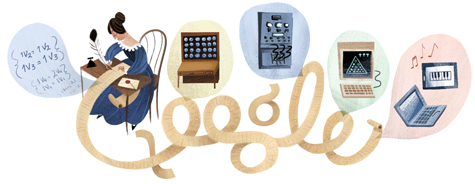
Ada's birthday celebration also helps kick off Computer Science Education Week (CSEdWeek) which, as a computer science educator (and friend of NCWIT), I am honored to support. CSEdWeek is a worldwide effort to increase interest and participation in the awesomeness that is CS. Lots of great resources on the CSEdWeek website, go check it out.
Finally, in other exciting FCS news, it turns out yesterday was Grace Hopper's birthday! Two famous FCSes were born one day apart. I think that's really cool. Any of you share birthdays with Grace or Ada? This is actually a fun math problem, and, indeed, forms the basis of a cryptological attack called the the birthday attack.
See! Not only is CS everywhere, but:

Ada's birthday celebration also helps kick off Computer Science Education Week (CSEdWeek) which, as a computer science educator (and friend of NCWIT), I am honored to support. CSEdWeek is a worldwide effort to increase interest and participation in the awesomeness that is CS. Lots of great resources on the CSEdWeek website, go check it out.
Finally, in other exciting FCS news, it turns out yesterday was Grace Hopper's birthday! Two famous FCSes were born one day apart. I think that's really cool. Any of you share birthdays with Grace or Ada? This is actually a fun math problem, and, indeed, forms the basis of a cryptological attack called the the birthday attack.
See! Not only is CS everywhere, but:


Monday, July 9, 2012
Kudos to Margo Seltzer
Margo Seltzer, fellow FCS, profesor at Harvard, and well known in the CS blogosphere, was featured in a great article in Txchnologist about women in CS. You can read the article here.
I love just about everything about the article, in particular Margo's comments on polo shirts:
In any case, kudos to Margo. Go read the article and check out her blog!
I love just about everything about the article, in particular Margo's comments on polo shirts:
Txch: The computer science community may not be able to control the way programmers are portrayed in the press, but it can at least control the image it projects. What are the big things they shouldn’t do if they want women to apply?And her comments on how sexism is less of a big deal to companies than racism:
MS: Here’s my favorite. I was chatting with a group of university reps from a very large high-tech company. The reps were both men and women, and they were bemoaning the fact that they found it very difficult to attract women programmers. I looked at them and I said to one of the women, “Are the company shirts you’re wearing men’s polos or women’s polos?” She said, “Oh, it’s a men’s polo shirt.” I said, “Why? Why don’t you buy women’s polo shirts? They would fit better.” And she says, “Well, there aren’t very many of us and it would cost more.”
Now, this is a multi-billion-dollar corporation. I looked at them and I said, “I run a company of 25 people, and you know what? We buy men’s and women’s polo shirts. You’re sending a message that says men are the norm and women are second-class citizens, so we have to put up with what they give us.” I’m sure not many women look at the polo shirts and say, “This isn’t for me,” but I still think it sends a very strong subliminal message.
The other data point is—look at the big annual events that these companies hold for all their customers. How many of the featured speakers are women? The answer goes from zero to one, amidst twenty or thirty speakers. You see this over and over. I think it sends a message that says, “We’re a guys’ company.” There are little things that a company could do to send a message that says, “We’re gender agnostic. We actually hire both boys and girls.”
Txch: Does it behoove companies to narrow the gender gap?I believe I've written about this topic before, where it's strangely acceptable to be sexist and ableist, but not racist. We really need to work on that if we have any hope of making progress.
MS: In the same way that we would not tolerate an environment that was blatantly racist. That would not be tolerated in any company in America. And yet we have these pockets in cultures of companies that really are very hostile towards women. People don’t seem to find that nearly as offensive.
In any case, kudos to Margo. Go read the article and check out her blog!
Monday, May 14, 2012
What the hell, Dell?
Last month, Dell ran a summit in Copenhagen with over 800 attendees, including Michael Dell himself. As an MC for the event they hired Mads Christensen, who apparently is well known in Denmark for making racist, sexist, and other sorts of remarks in bad taste.
Christiane Vejlo was in the audience and tweeted and blogged about some of the comments Christensen made. He started out by noticing the majority of people in the crowd were men and said:
The worst part is apparently Dell's response to complaints were along the lines of, "But, of course we support women! We were just trying to be funny. Ha ha. Can't you take a joke?"
I guess they realized this wasn't a good reply, so then they said something along the lines of, "We're sorry if we offended anyone." That "if" suggesting it is a woman's (or man's) fault if they were offended.
Molly Wood at CNET recently wrote about the event, and noted that apparently Dell has a precedent of being rather anti-women. In 2009 they had a marketing campaign suggesting women only used computers for dieting and shopping (you forgot knitting!), and it also settled a $10 million lawsuit over pay discrimination.
Dell, I am shaking my rolling pin at you. (Which I can do when I'm not baking your face off.)
Christiane Vejlo was in the audience and tweeted and blogged about some of the comments Christensen made. He started out by noticing the majority of people in the crowd were men and said:
"The IT business is one of the last frontiers that manages to keep women out. The quota of women to men in your business is sound and healthy".
Then he points out the very few women in the room and says, "What are you actually doing here?"
...
After the break Mads Christensen shares with us his whole “show” about the bitchy women who want to steal the power in politics, boards and the home. “Science” he calls it and mentions that all the great inventions come from men. “We can thank women for the rolling pin,” he adds. And then the moderator of the day finishes of by asking all (men) in the room to promise him that they will go home and say, “shut up, bitch!”.Sigh.
The worst part is apparently Dell's response to complaints were along the lines of, "But, of course we support women! We were just trying to be funny. Ha ha. Can't you take a joke?"
I guess they realized this wasn't a good reply, so then they said something along the lines of, "We're sorry if we offended anyone." That "if" suggesting it is a woman's (or man's) fault if they were offended.
Molly Wood at CNET recently wrote about the event, and noted that apparently Dell has a precedent of being rather anti-women. In 2009 they had a marketing campaign suggesting women only used computers for dieting and shopping (you forgot knitting!), and it also settled a $10 million lawsuit over pay discrimination.
Dell, I am shaking my rolling pin at you. (Which I can do when I'm not baking your face off.)
Tuesday, May 8, 2012
May CACM: Women Say What?
So I was reading the May issue of Communications of the ACM* today, and came across one of those lovely field naval gazing articles, "An n-gram analysis of Communications 2000-2010", by D. Soper and O. Turel. You don't really need to know what n-grams are for this blog post, suffice to say it's a way of analyzing gobs of text to try to figure out word usage patterns.
The tagline in the magazine for this article is, "Applied to almost 3,500 articles [this article] reveals computing's (and Communications') culture, identity, and evolution." This description is pretty apt - as I said, lots of field naval gazing.
So I get to the point in the article where the authors start discussing changes in writing style in the magazine over the past 10 years, and came across this nugget:
A far more likely explanation is writing bias. In 2012, the primary staff columnists at CACM are men (10 of 13) and the primary editorial board members are men (9 of 10). How often do the staff columnists call female computer scientists for quotes in articles? How often do they profile the research of women? How often does the editorial board correct authors who use gendered language in their contributed articles?
I agree there is a gender gap in computing, but I do not believe that explains Soper and Turel's pronoun results very well.
-----------------
* For the non-Computer Scientist readers out there, Communications of the ACM (or CACM) is a monthly magazine put out by our primary professional organization. In addition to the typical society magazine stuff, it also contains peer-reviewed research articles.
The tagline in the magazine for this article is, "Applied to almost 3,500 articles [this article] reveals computing's (and Communications') culture, identity, and evolution." This description is pretty apt - as I said, lots of field naval gazing.
So I get to the point in the article where the authors start discussing changes in writing style in the magazine over the past 10 years, and came across this nugget:
Our n-gram analysis also revealed changes in Communications' use of gender-related terms from 2000 to 2010. On average, masculine pronouns (such as "he", "his", and "him") appeared 277% more often than feminine pronouns (such as "she", "hers", and "her"). Moreover, the gap widened from 190% in 2000 to more than 290% in 2010. One possible explanation is the gender gap between male and female computing professionals also grew and was wider in 2010 than it was at any time in the previous 25 years.Say what?
A far more likely explanation is writing bias. In 2012, the primary staff columnists at CACM are men (10 of 13) and the primary editorial board members are men (9 of 10). How often do the staff columnists call female computer scientists for quotes in articles? How often do they profile the research of women? How often does the editorial board correct authors who use gendered language in their contributed articles?
I agree there is a gender gap in computing, but I do not believe that explains Soper and Turel's pronoun results very well.
-----------------
* For the non-Computer Scientist readers out there, Communications of the ACM (or CACM) is a monthly magazine put out by our primary professional organization. In addition to the typical society magazine stuff, it also contains peer-reviewed research articles.
Tuesday, May 1, 2012
How to get started with programming
I am often asked:
For kids, two of the best resources I know of are Scratch and Alice. I also think Computational Fairy Tales and Computer Science Unplugged are excellent resources for kids.
For girls in particular, there is Dot Diva, for girls of color, Black Girls Code.
For older kids and grownups, and those with a perchant for Art and visualization, I highly recommend Processing.
For grownups, I recommend Udacity.
This should be enough to get you and your kids up and running. Have fun!
How can I teach my kid to program?And:
How can I learn to program?I'm glad you asked! I probably should have answered your questions during CS Education Week, but it appears I'm about 5 months too late for that.
For kids, two of the best resources I know of are Scratch and Alice. I also think Computational Fairy Tales and Computer Science Unplugged are excellent resources for kids.
For girls in particular, there is Dot Diva, for girls of color, Black Girls Code.
For older kids and grownups, and those with a perchant for Art and visualization, I highly recommend Processing.
For grownups, I recommend Udacity.
This should be enough to get you and your kids up and running. Have fun!
Wednesday, March 21, 2012
That's what she (really) said
Great post from Jessamyn Smith on the Geek Feminism blog. You should read the whole post for how she brilliantly countered a bunch of male colleagues telling her to "lighten up" about a joke she didn't find very funny. Here's an excerpt:
I work at a startup, and most of the time, I enjoy it. Compared to most tech companies, and certainly most startups, we have quite a few people who are relatively clueful. There are relatively few moments of “brogrammer” culture. There is, however, one thing that has been bugging me for months, ever since it was introduced.
I took it for granted that everyone was familiar with the “That’s what she said,” joke, but a recent conversation with a consultant friend made me realize some industries don’t feature it on a daily basis. For those who haven’t heard it a million times, the idea is that when somebody says something that could remotely be turned into a sexual joke, e.g. “I’m trying to solve this problem but it’s really hard!” you say “That’s what SHE said,” in a lascivious tone.
Now, I admit to having made this joke myself, at times. Once in a while, I even find it funny. What I don’t find funny is a bot we have in our general IRC channel at work, that has some basic AI devoted to determining when to interject TWSS into the conversation.
I asked a number of times to have that bot function turned off, but got the usual combination of being ignored, being told it’s funny, and being told I should lighten up. I tried explaining once why it was objectionable, and managed to get the guys saying variations, e.g. “That’s what your DAD said,” for an evening, but that was about it.
Kudos, Jessamyn! Well played. I only wish I could be half that clever when encountering such situations.Last Friday, the bot went a bit crazy and started throwing TWSS into the conversation with no apparent rhyme or reason. Finally, I had had enough. And then it came to me: I would write my OWN bot, that responded to TWSS with a quotation from a notable woman. If they are so keen on what she said, why don’t we get educated about what she really had to say. And so the “whatshereallysaid” bot was born. It might annoy the guys into shutting off the TWSS bot, or we might all learn about notable women. It’s a win either way, in my books!
Friday, February 10, 2012

Monday, February 6, 2012
My favorite Google easter eggs
Teaching prep is killing me this semester, so I think it's time for cheap thrills. Here are my favorite Google easter eggs:
1) Search for "do a barrel roll"
2) Search for "tilt" (or "askew")
3) Search for "anagram"
4) Search for "recursion"
The last one is my favorite. More to come in t-minus 53 days!
Tuesday, January 24, 2012
Paper top 40 predictions
I've decided I am absolutely terrible at predicting which papers will be "a hit" and which papers will never get cited or read.
Like most academics, I'm usually working on several papers at the same time. In my mind as we're preparing and submitting, I often place bets on how the reviews will come back. Formulating my prediction involves not only the content of the paper, but also the publication venue, who I expect the reviewers might be, and other misc. variables.
I'm nearly always wrong.
And post-publication, the papers I am most proud of are never cited. The papers I am most ashamed of are frequently cited. I am considering employing reverse psychology as I write.
Either that or switch into mobile computing. Those people are so connected every paper has a gazillion citations.
Like most academics, I'm usually working on several papers at the same time. In my mind as we're preparing and submitting, I often place bets on how the reviews will come back. Formulating my prediction involves not only the content of the paper, but also the publication venue, who I expect the reviewers might be, and other misc. variables.
I'm nearly always wrong.
And post-publication, the papers I am most proud of are never cited. The papers I am most ashamed of are frequently cited. I am considering employing reverse psychology as I write.
Either that or switch into mobile computing. Those people are so connected every paper has a gazillion citations.
Wednesday, January 18, 2012
Signal Boost: Stop the Internet Blacklist Bills
If you went to google.com, boingboing.net, wikipedia, or dozens of other sites on the net today, you may have noticed they have been blacked out in protest. This was done to bring the public's attention to two bills before congress: SOPA (Stop Online Piracy Act) and PIPA (Protect IP Act).
Why the protest? Well, these bills were intended to curb online piracy and copyright infringement (good), but did so in a really technologically uninformed and dangerous way (bad).
In addition to these bills not actually helping curb online piracy, they grant an incredible amount of leeway to allow the government and companies to arbitrarily censor and monitor the communication of people using the internet, both in our country and abroad. A few fun nuggets about the PIPA bill, quoted from publicknowledge.org :
There is a lengthy list of reputable organizations protesting these bills, including legal scholars, human rights organizations, industry groups, and engineers. Also, Joi Ito, director of the MIT Media Lab and fellow CS blogger, has a great post summarizing this issue, as does Trevor Trimm of the Electronic Frontier Foundation.
I urge you to take action and urge your congress members to reject this bill.
Why the protest? Well, these bills were intended to curb online piracy and copyright infringement (good), but did so in a really technologically uninformed and dangerous way (bad).
In addition to these bills not actually helping curb online piracy, they grant an incredible amount of leeway to allow the government and companies to arbitrarily censor and monitor the communication of people using the internet, both in our country and abroad. A few fun nuggets about the PIPA bill, quoted from publicknowledge.org :
- PIPA is overbroad. By including "information location tools," it makes nearly every actor on the Internet a potential violator.
- PIPA is bad international precedent. By sanctioning government interference with DNS, it would be used as justification for other countries to hinder freedom of expression of online.
- PIPA is ripe for abuse. By creating a "private right of action," rights holders could directly go after payment processors and ad networks.
- PIPA speeds fragmentation of the Internet. By targeting DNS, it could lead to a fragmentation of the Internet, running contrary to the U.S. government's commitment to advancing a single, global Internet.
There is a lengthy list of reputable organizations protesting these bills, including legal scholars, human rights organizations, industry groups, and engineers. Also, Joi Ito, director of the MIT Media Lab and fellow CS blogger, has a great post summarizing this issue, as does Trevor Trimm of the Electronic Frontier Foundation.
I urge you to take action and urge your congress members to reject this bill.
Thursday, January 5, 2012
Fun with Google
You know that game where you type something into Google and note its wacky suggestions? I have no idea why, but I tried it today with 'Professors are'. This is the result:


So it would appear I am a candy bar, overpaid, and super-mean. Excellent! Ready for the Spring semester to start.
I also tried 'Computer Scientists are', and this is the result:

I suppose 3/4 ain't bad (I kind of like the blank one...)
Tuesday, December 20, 2011
NRC Computer Science Rankings Reprise
There's an article in CACM this month by Computer Scientists Andrew Bernat and Eric Grimson, Doctoral Program Rankings for U.S. Computing Programs: The National Research Council Strikes Out. It talks about the ways in which NRC rankings are broken for CS (we have heard this before), but it details ways in which it could be fixed, which we hadn't heard before, and I like.
Two suggestions I thought were good:
Two suggestions I thought were good:
- "Explore making the rankings subdiscipline-dependent. It is clear that different departments have different strengths. Thus, enabling a finer-grained assessment would allow a department with strength in a sub-field, but perhaps not the same across-the-board strength, to gain appropriate visibility. This may be particularly valuable for students deciding where to apply."
- "Use data mining to generate scholarly productivity data to replace commercially collected citation data that is incomplete and expensive."
The first is a nice idea; for example, you might be interested in a top ranked department, but it turns out 19/20 faculty focus on Theory and you actually want to do Systems. Or there might be some school with three top faculty exactly in your subspecialty, but you don't see them because they're 93rd in the rankings.
The second is nice as well; I think with Google Scholar Citations data available this turns out to be a trivially easy problem to solve.
Maybe CRA can do their own rankings; they collect a lot of their own data anyway, and it avoids needing to rely on the NRC.
Monday, December 12, 2011
New adventures in publishing metrics
In case you haven't heard, Google Scholar Citations recently opened its doors, allowing academics to set up Google Scholar profiles, track their citations, h-index and i10-index, and see pretty graphs.
At first I thought: Yay! Especially since, for Computer Science, this was right on the heels of Cite Scholar's beta release, which is all about highlighting the fact that in CS we're all about the top tier conferences and journals don't matter much for us.
Then I thought: Boo! Now it's easier for the bean counters to count beans. Also, I sense there's this "who's searched for me" button coming, which creeps me out. This is actually why I don't ever click on academia.edu pages.
After a few weeks of reflection I am still on the fence. While I can't speak for other fields, in CS number of citations doesn't necessarily mean anything about quality or impact of work. I can think of several lackluster papers that have hundreds of citations, whereas others are incredible and barely hardly any. Also, sometimes an insane number of citations simply means youforced encouraged people to cite you by releasing some software or data.
On the other hand, I find these new graphs seem to ignite my "MUST WRITE MORE" instinct, just as the darling tune my new washing machine plays encourages me to do more laundry.
At first I thought: Yay! Especially since, for Computer Science, this was right on the heels of Cite Scholar's beta release, which is all about highlighting the fact that in CS we're all about the top tier conferences and journals don't matter much for us.
Then I thought: Boo! Now it's easier for the bean counters to count beans. Also, I sense there's this "who's searched for me" button coming, which creeps me out. This is actually why I don't ever click on academia.edu pages.
After a few weeks of reflection I am still on the fence. While I can't speak for other fields, in CS number of citations doesn't necessarily mean anything about quality or impact of work. I can think of several lackluster papers that have hundreds of citations, whereas others are incredible and barely hardly any. Also, sometimes an insane number of citations simply means you
On the other hand, I find these new graphs seem to ignite my "MUST WRITE MORE" instinct, just as the darling tune my new washing machine plays encourages me to do more laundry.
Wednesday, December 7, 2011
Computer Science Education Week
I forgot to mention this before, but this week is Computer Science Education Week. The website has some pretty great resources for helping encourage you, your students, your kids, etc for getting started in CS, including links to Alice and Scratch (fun starter languages I've always loved), Computational Fairy Tales (which I'd never seen before but really love now!), Computer Science Unplugged (from our friends over at NCWIT), and a wealth of other things.
I really like their Which Computer Scientist Are You page, because it contains women and people of color. You can guess who I'd pick...
I really like their Which Computer Scientist Are You page, because it contains women and people of color. You can guess who I'd pick...
Thursday, December 1, 2011
NSF Fastlane: Party like it's 1999
I know the government is a monolith.
I know the government does not have any in-house software developers anymore to write and maintain software.
I know these are Troubled Economic Times.
But, still, what's up with Fastlane? This system is a dinosaur snail. I've had simple figureless PDFs take a century to distill.
NSF, if you fund me, in addition to doing amazing research I'll stick a few of my a-ma-zing undergrads on revamping Fastlane. Actually, I'll make it a class project and stick a gazillion undergrads on it. Give us a semester, that puppy will zip.
I know the government does not have any in-house software developers anymore to write and maintain software.
I know these are Troubled Economic Times.
But, still, what's up with Fastlane? This system is a dinosaur snail. I've had simple figureless PDFs take a century to distill.
NSF, if you fund me, in addition to doing amazing research I'll stick a few of my a-ma-zing undergrads on revamping Fastlane. Actually, I'll make it a class project and stick a gazillion undergrads on it. Give us a semester, that puppy will zip.
Thursday, November 17, 2011
Signal Boost: Stand With Science
Junior PI Scientist-Mom-Wife wrote to ask me to signal boost Stand With Science, and I am more than happy to oblige. I'm actually going to repost her words here, to tell you about this effort.
Readers, please sign this letter. Bloggers, please blog about this. Make some noise. The last thing we want to do in this economy is cut STEM research funding - let's send a strong message to Congress.
Next week the Congress Joint Select 'super' Committee on Deficit Reduction will decide where to make the next big cuts. If they do not agree or find a plan to reduce spending, sweeping cuts will be put into effect that will likely affect everyone in science and academia.Here's the video:
A group of MIT students have started a letter urging Congress not to cut science funding and they are amassing signatures. They include an amazing video that describes the importance of science, engineering and technology to our daily lives and to American jobs. It's a positive message, and really accessible to the public.
There are now about 7000 signatories on this letter, including Nobel Prize winners and numerous well known scientists (you can view signatories Bob Horvitz #6854, Philip Sharp #6866, Bob Weinberg #6846, Susan Lindquist #6727, Doug Melton #6994, Ray MacDonald#3652, Gary Ruvkun #3712, Didier Stainier #4064, Richard Hynes, Luisa Iruela-Arispe #5087, Andrew Ewald #6899, etc...) and the number keeps growing.
The video and petition have clearly gone viral, which is great. The main message is that the future of science is at stake.
This video and letter have been covered by the NY Times, Science (AAAS) and many other news organizations and blogs. We need faculty and respected scientists to help further this worthy request to Congress.
If you have time, please view the MIT student video and consider signing the letter.
Readers, please sign this letter. Bloggers, please blog about this. Make some noise. The last thing we want to do in this economy is cut STEM research funding - let's send a strong message to Congress.
Thursday, October 27, 2011
Even your mom can write this blog post
For those of you who subscribe to IEEE Spectrum email alerts, you may have seen today's snafu where there was an oopsie headline for one of their articles - "With the Arduino, Now Even Your Mom Can Program."
The article and headline were quickly revised post-publication, though I noticed in google's cache that the original article contained the following quote, "'Now, even my mom can program,' Banzi says."
The editor of the journal, who is a female engineer, was Not Amused, nor were the dozens of commenters on the article. I'm glad they fixed it.
But I think this journalistic error raises a larger societal issue when discussing ability and technology. We seem to more quickly ascribe technological inability to female elders, and technological ability to male youths.
For example, I tend to hear, "Even my grandma could use it." far more often than, "Even my grandpa could use it". And I recently saw a comic in a magazine where mother calls technical support and says, "Normally my toddler son would help me fix the computer, but he's in time out." Why wasn't that a female toddler in the cartoon? Why in movies is the clever geek / scientist who saves the day always a man?
I really would like the media to make greater strides in not playing to tropes, because it tends to reinforce these tired ideas that women are unable to be technologically savvy.
The article and headline were quickly revised post-publication, though I noticed in google's cache that the original article contained the following quote, "'Now, even my mom can program,' Banzi says."
The editor of the journal, who is a female engineer, was Not Amused, nor were the dozens of commenters on the article. I'm glad they fixed it.
But I think this journalistic error raises a larger societal issue when discussing ability and technology. We seem to more quickly ascribe technological inability to female elders, and technological ability to male youths.
For example, I tend to hear, "Even my grandma could use it." far more often than, "Even my grandpa could use it". And I recently saw a comic in a magazine where mother calls technical support and says, "Normally my toddler son would help me fix the computer, but he's in time out." Why wasn't that a female toddler in the cartoon? Why in movies is the clever geek / scientist who saves the day always a man?
I really would like the media to make greater strides in not playing to tropes, because it tends to reinforce these tired ideas that women are unable to be technologically savvy.
Friday, October 7, 2011
Ada Lovelace Day 2011
I just realized I nearly missed Ada Lovelace Day (ALD) which is today. (I'm bad with dates, so thanks to Beki for reminding me.)
The person I'd like to honor for ALD is my best friend, who I'll call Sarah. Sarah is actually the person who got me into computers when we were kids. She was always tinkering with electronics in her basement, taking her computer apart, and writing programs. She took all the advanced level science and math classes our school offered, and got top grades. And she was also "cool" - into underground bands, fashion, etc. I tried my best to copy her, though I must admit I got a C in Physics and still don't know how the hell eyelash curlers work.
Sarah was my first female technical role model, and I'm happy to say we're still close friends, and both still working in technology. If this blog wasn't pseudo-anonymous I would brag about what she's currently doing. Suffice to say it is *fabulous*!
The person I'd like to honor for ALD is my best friend, who I'll call Sarah. Sarah is actually the person who got me into computers when we were kids. She was always tinkering with electronics in her basement, taking her computer apart, and writing programs. She took all the advanced level science and math classes our school offered, and got top grades. And she was also "cool" - into underground bands, fashion, etc. I tried my best to copy her, though I must admit I got a C in Physics and still don't know how the hell eyelash curlers work.
Sarah was my first female technical role model, and I'm happy to say we're still close friends, and both still working in technology. If this blog wasn't pseudo-anonymous I would brag about what she's currently doing. Suffice to say it is *fabulous*!
Wednesday, September 14, 2011
Kudos, ACM!
Kudos to ACM for featuring two prominent Female Computer Scientists on in this month's Communications of the ACM (CACM) -- Jeannette Wing and Barbara Liskov (via Valerie Barr). I especially enjoyed reading Valerie's article about Barbara's keynote at Grace Hopper. Barbara is the second woman to win the Turing Award, which is basically the Nobel Prize for Computer Science. I liked this:
Anyway, good stuff, check it out if you have the chance.
"Liskov talked about her technical work that ultimately led to the Turing Award. Much of her work was motivated by an interest in program methodology and the questions of how programs should be designed and how programs should be structured. So, after receiving the Turing Award, she went back and reread the old literature, discovering anew that there is great material in old papers and that her students were unaware of it. So, she is now pointing people to these papers and encouraging people to read them.
I recently had a similar "everything new is old again" epiphany. I was looking up a paper that everyone cited and realized it was far too recent. So I went down the citation rabbit hole and found the original paper, written over 30 years ago. And, wow, great ideas - but they completely got lost in the whisper-citation-down-the-lane effect.For example, three key papers she cited are:
- Edsger Dijkstra, "Go To Considered Harmful," Communications of the ACM, Vol. 11, No. 3, March 1968, pp. 147–148.
- Niklaus Wirth, "Program Development by Stepwise Refinement," Communications of the ACM, Vol. 14, No. 4, April 1971, pp. 221–227.
- David Parnas, "Information Distribution Aspects of Design Methodology," IFIP Congress, 1971."
Anyway, good stuff, check it out if you have the chance.
Subscribe to:
Posts (Atom)