Showing posts with label news. Show all posts

Sunday, July 28, 2013

Narendra Modi fans launch Namo Android smartphone

namo_smartphone.jpg


A group, claiming to be "independent body of fans of Shri Narendra Modi", has launched the Namo Android smartphone that will be available 'soon'.

Namo, is short of course for Narendra Modi, the Chief Minister of Gujarat, and Chairman of Central Election Campaign Committee of Bharatiya Janata Party (BJP), one of India's leading political parties. Namo is also, the group shares, short for, Next-generation Android Mobile Odyssey, as the Namo phone is based on Android.

Explaining the motivation in releasing the phone, the group says on its website, "We are fans of Shri, Narendra Modi, our forthcoming future leader of our great nation India, we are manufacturing latest Android handset dedicated to the IRONMAN of modern India."

The website is scant on details about Namo, the smartphone, though it does mention some of the specifications. Namo will sport a 5-inch Corning Glass 2 display and be powered by a 1.5GHz quad-core Mediatek MT6589 chipset. It will have a 13-megapixel camera. The phone will supposedly come in 4 variants, with the amount of RAM and internal storage varying between 1-2GB and 16-64GB respectively. There's no word yet on the price or availability of Namo smartphone.

To be clear, it seems what the group plans to do is import off-the-shelf smartphones from China to rebrand and market them, similar to what many other Indian smartphone brands are already doing. Will the group be around to service the Namo smartphone if and when it runs into issues is anyone's guess.

"We are from land of Gujarat & in electronic smartphone business in China," the group says. "Our product is our way of dedication & respect to our great nation leader. We will be launching NAMO Android handset with Shri Narendra Modi "signature edition", for which process in under way! We will launch our handset very soon..

Friday, July 26, 2013

Cisco to buy Sourcefire, more network security deals seen

cisco-wall-635.jpg

Cisco Systems Inc said on Tuesday it plans to purchase cyber-security company Sourcefire Inc for $2.7 billion, a deal that analysts say should spark more acquisitions in the industry as large vendors seek to profit from growing demand for IT security.

Cisco, which has been seeking targets to boost its network security business, said it will pay $76 per share in cash for Sourcefire, a premium of 28.6 percent over its closing price on Monday of $59.08.
"We looked broadly at all the major players. Sourcefire fit perfectly," Cisco's business development chief Hilton Romanski said in an interview.

Cisco has made it a priority to improve its security and is pushing to offer multiple security capabilities in hardware, software and cloud. Sourcefire is strong in intrusion detection and protection appliances, which is one of the higher growth segments within security.

Sourcefire shares rose 27.8 percent to $75.51 in afternoon trading while Cisco stock was down 0.3 percent at $25.64.

Analysts said the valuation may be high but the deal made sense for Cisco, which has lost market share in network security to small, innovative rivals such as Juniper Networks Inc, Check Point Software Technologies, and Palo Alto Networks Inc.

Cisco wants to be the top player in security and shed its reputation of lagging in that area, company security head Chris Young told analysts on a conference call.

"We will not rest until we are the number one security partner for our customers, hands down," Young said.
More acquisitions should be on the way in the tech security sector, which Research firm IDC has said spending this year should generate 7.8 percent revenue growth for vendors.

"We view this morning's news as 'game changing' for the cyber security space as we expect a surge of consolidation to take place over the next 12 to 18 months," Daniel Ives, a tech analyst with FBR Capital Markets, said in a research note.

He added that larger technology players such as IBM, Juniper, Symantec, and EMC could look to acquire smaller security players to help drive growth given the high priority security has in IT spending.
Brian White, an analyst at Topeka Capital Markets, said Dell and Hewlett Packard could also be seeking to expand their security offerings, and the Sourcefire acquisition could be the beginning of more transactions.

Potential targets are smaller, more nimble companies that provide up-to-date network security to combat advanced hacking attacks. Security protection needs have grown more complex with the proliferation of web applications, social media and video streaming.
Palo Alto Networks, Fortinet as well as privately held FireEye and Barracuda Networks are considered top picks.

FBR's Ives said Fortinet could be worth around $39 a share for example. Fortinet shares rose 5.5 percent to $21.57 in afternoon trading.

Cisco said it will integrate Sourcefire, based in Columbia, Maryland, into its security business. Sourcefire founder and Chief Technology Officer Martin Roesch and other top executives will join Cisco's security group.
BMO analyst Tim Long said adding Sourcefire gives Cisco's business about 20 percent more scale and improves the cloud security offering.

"We see this acquisition turning Cisco's security business from low single-digit growth to mid high-single-digit growth," Long said.

Cisco said the deal should close during the second half of this year, and it expects the acquisition to be slightly dilutive to non-GAAP earnings in fiscal year 2014.

Young did not rule out further acquisitions because cyber security threats were constantly changing and adversaries were well-funded.
"As the landscape changes we will respond, organically and non-organically," Young said.
Cisco Chief Executive John Chambers said in December that Young had a "blank check" to overhaul the business.

RBC Capital Market analyst Mark Sue said in terms of acquisition targets "product, platform, channel integration will be important for Cisco, which has yet to be the customer's first choice for security".
Centerview Partners advised Cisco on the deal.
Sourcefire hired Qatalyst partners, according to a source familiar with the matter.
© Thomson Reuters 2013

Average Internet speed in India up 21 percent to 1.3Mbps: Akamai

internet-battle-635.jpg

Global average Internet speeds have crossed the 3Mbps mark, while average Internet speeds in India are slightly above the 1Mbps mark, according to Akamai Technologies' State of the Internet report for the first quarter of 2013.

Akamai is an Internet content delivery network and the report is based on data collected from the Akamai Intelligent Platform. According to Akamai, the measurements published in the quarterly State of the Internet Report are taken from requests made to Akamai's HTTP/S platform across more than 200 countries.

India ranks 114 globally, in terms of average Internet speed, at 1.3Mbps which was up 20 percent compared to the last quarter and up 21 percent compared to the same quarter, last year.

Peak connection speeds in India were at 10.6Mbps, trailing behind Thailand, Indonesia, Philippines and Vietnam. However, the peak speed has seen a 27 percent sequential increase and a 34 percent year on year increase according to Akamai.

Only 0.3 percent Internet users in India enjoy speeds of more than 10Mbps, while 2.4 percent have access to Internet connections with speeds 4 Mbps or more. Akamai gauges broadband adoption by looking at percentage of users getting connection speeds of 4 Mbps or more. This figure increased by 33 percent quarter on quarter and 66 percent year on year in India. 

Similarly, Akamai considers speeds above 10Mbps as high Broadband. In India there was a 102 percent increase quarter on quarter and  an 85 percent year on year increase in the number of Internet connections with speeds 10Mbps or more

Globally, around 46 percent Internet users enjoy speeds of 4Mbps or above, while 13 percent users have a 10Mbps+ Internet connection.

South Korea ranks number one in terms of average connection speeds at 14.2 Mbps, while Hong Kong ranks number one in terms of peak connection speeds at 63.6Mbps. Looking at adoption rates, Switzerland was at the pole position with 88 percent of Internet users enjoying connection speeds of 4Mbps or more, while South Korea topped the charts in the high speed broadband adoption category with 50 percent users getting speeds of 10Mbps or more.

Akamai also adds that there are 16.28 million unique IP addresses in India. Last quarter, India had 14.27 million unique IP addresses.

China, Indonesia leading sources of online attacks: Study

china-internet-problem-635.jpg

China and Indonesia headed the list of 177 countries named as sources of Internet attacks, a security survey said Tuesday.
The survey from US security firm Akamai found China remained at the top of the list in the first quarter of 2013, but its share of all attacks dropped to 34 percent from 41 percent in the fourth quarter of 2012.
"This decline is likely related to Indonesia making a sudden appearance in the second place slot," said Akamai's Bill Brenner, noting that Indonesia's share of cyber-attacks surged to 21 percent from just 0.7 percent in the prior quarter.
The United States was the third largest source, but its share dropped to 8.3 percent from 10 percent earlier.
The next largest sources of cyber-attacks were Turkey (4.5 percent), Russia (2.7 percent), India (2.6 percent), Taiwan (2.5 percent), Brazil (2.2 percent), Romania (2.0 percent) and Hong Kong (1.6 percent).
"We find that nearly 68 percent originated in the Asia Pacific/Oceania region, up from 56 percent in the fourth quarter of 2012, likely due to the massive increase seen in Indonesia," Brenner said.
"Europe accounted for just under 19 percent, while North and South America originated just over 13 percent combined."
Akamai also noted a four percent increase in the global average connection speed to 3.1 megabits per second.
South Korea had the highest average connection speed at 14.2 Mbps and remained the country with the highest level of "high broadband" adoption, growing to 50 percent, the report said.
The report estimated more than 733 million unique Internet addresses from 243 countries or regions connected to the Akamai platform, an increase of 3.1 percent over the previous quarter and 10 percent year over year.
Since a single IP address can represent multiple individuals in some cases, Akamai estimated the total number of unique Web users connecting to its platform during the quarter to be well over one billion.

Internet Explorer 11 developer preview now available for Windows 7

IE11-win7.jpg

Microsoft has released a developer preview version of Internet Explorer 11 (IE11) for Windows 7.

As promised by the Redmond giant after it released the consumer preview version of Windows 8.1 with the new iteration of the browser last month, the browser can be downloaded from Microsoft's Window's website.

Microsoft announced the development on its MSDN blog and said that Internet Explorer for Windows 7 offers the same improved performance, faster page load times, new standards support for next generation sites, and completely revised F12 developer tools, that the browser's Windows 8.1 version offers.

According to Microsoft, IE11 is the first browser to natively decode JPG images in real-time on the GPU (Graphics processor), that allows web pages to load faster and use less memory, reducing power consumption and improving battery life of devices. IE11 also boasts of being the first browser to render text on the GPU. Microsoft also claims that the updated version of Internet Explorer is the first browser to implement the W3C Resource Priorities standard allowing developers to specify which parts of the page are important and need to be loaded first. It also supports HTML5 link prefetching and pre-rendering, letting developers guide the browser anticipate where users are expected to go next and get those pages ready.

The update brings some under the hood changes including support for hardware accelerated 3D web graphics with support for WebGL. It also supports plug-in free HTML5 video and the latest standards for closed captioning, adaptive streaming, wherein the quality of the video is adjusted depending on the available bandwidth, and rights management.

Microsoft has also made improvements to its JavaScript engine, Chakra with Internet Explorer 11.

According to the company, IE11 on Windows 7 is 4 percent faster than IE10, and nearly 30 percent faster than Chrome in JavaScript benchamark tests like SunSpider.
IE11 also features a completely overhauled suite of in-browser F12 developer tools. These tools help Web developers diagnose and optimize their apps quickly and efficiently, a sper Microsoft.

The browser's Windows 8.1 avatar offers additional features optimised for touch-screens including  swipe gestures for going forward and back and supports Windows 8.1's side by side mode allowing users to browse two websites on different instances of the browser on one screen.
As with any preview software, users are advised not to use the software as their primary browser, as it's likely to have some bugs.

Friday, July 19, 2013

GlassUp plans a sexier, cheaper take on Google Glass


A team of Italian designers has plans for a simpler, cheaper, and more stylish take on Google Glass. The GlassUp team announced Tuesday that it is raising money to produce its Glass competitor.
GlassUp, an IndieGogo project seeking to raise $150,000 to take its augmented eyewear to production, says that the team showed off its first prototype in January at the Consumer Electronics Show. The team hopes to deliver its first production models by February 2014 for an estimated price of $299, it said.
According to Francesco Giartosio, GlassUps’ chief executive, one of the chief differences between Google Glass and the GlassUp eyewear will be in how the device displays data; instead of projecting information onto the edge of the glass from an offset projector, GlassUp will use a dedicated lens embedded in the glass itself.

That will allows GlassUp to overlay monochromatic text directly “ahead” of the user’s eye, which Giartosio said was more ergonomic. GlassUp’s display has a resolution of 320 by 240 pixels.
GlassUp overlay
What life is like looking through GlassUp’s glasses.
With Google, “you have to lift up your eyes,” Giartosio said. “”It’s not comfortable and can’t be good for you continuously.” GlassUp weighs about 1.5 ounces, he said, with a battery life of 150 hours of standby time and 8 hours of normal usage
.
GlassUp is just one of a number of companies vying to be the next big thing in “wearable computing,” with the argument being that consumers will eventually grow too lazy to haul their smartphone out of their pocket. Instead, a number of Google Glass competitors have developed wrist-mounted devices including the Pebble or the rumored Apple iWatch to provide glanceable information.

But while Glass is a standalone device, GlassUp characterizes its glasses as “basically a second screen output for your devices,”  that connect via Bluetooth to your phone or tablet.

As such, it will be “read only,” only able to receive information—unlike Glass, which can be used to send information back and forth. GlassUp will also forego voice input—something that will arrive in a future generation, according to Giartosio—and there won’t be a camera included for recording photos and video, either. However, sensors including an accelerometer, compass, ambient light sensor, and a precision altimeter are included.

The GlassUp glasses include a touchpad on the right side of the eyewear, which GlassUp says will support gestures such as swiping, as a means to avoid tapping on your phone all the time.
GlassUp swipe
The information that GlassUp displays will be dependent on what sort of apps that you download. Giartosio says that GlassUp will develop five to ten apps on its own, and that 100 developers are already hoping to take a crack at GlassUp with their own apps.

The company envisions GlassUp projecting messages, tweets, and real-time directions on the screen, overlaying the “real world” that’s visible though the glasses. However, it’s difficult to see how apps that showed real-time translations of movies would work with GlassUp, as it lacks both a camera and audio sensors.

However, while Google has refined its industrial design, Giartosio says that GlassUp is located in northern Italy—right smack in the middle of eyeglass designers like Luxottica, Safilo, Marcolin, De Rigo, who design eyeglass brands like Ray-Ban, Oakley and others. The company will develop two models, a basic and a “sporty” model.

Samsung unveils super duper high-speed 1TB SSDs

Samsung Electronics will offer a range of faster SSD drives for consumers from next month, including a zippy new 1TB drive meant for everyday use.
The company’s “840 EVO lineup” will be two to three times faster than its existing 840 drives, depending on the capacity, it said Thursday. The 1TB version has a sequential write speed of 520MBps, over double its predecessor, while the 120GB model can reach up to 410MBps, about triple the older version.
As NAND flash prices fall and adoption of SSDs spreads in consumer computers and laptops, terabyte-sized SSDs have become the new battleground for manufacturers. Samsung announced its newest drives under the slogan “SSDs for everyone.”
Micron unveileda 1TB drive, the Crucial M500, for consumers in January at the International CES show in Las Vegas, pricing it under $600, or 60 cents per gigabyte, far below rivals at the time. The first 1TB SSD, from OCZ, launched in 2011, still sells for over $2,500 online.

Samsung has yet to reveal the price for its 840 EVO, which it said will go on sale in August in major markets. The company’s sequential read/write speeds are slightly faster than Micron’s product, as are its 98,000 input/output operations per second (IOPS) and 90,000 IOPS random read and write speeds.
The new SATA-based, 2.5-inch drives will come in sizes ranging from 120GB to 1TB, and will use Samsung’s NAND flash built using process technology smaller than 20 nanometers. The company’s previous consumer drives maxed out at 250GB.

Samsung also announced a new lineup of SSDs for enterprise storage, including a 1.6TB drive that has a sequential read speed of 2,000MBps and a random read speed of 740,000 IOPS. The company said it is the fist to build a 2.5-inch SSD based on NVMe (non-volatile memory express), an interface specification for solid-state drives that replaces the SATA interface now widely in use.

The 2.5-inch enterprise drives will also come in 400GB and 800GB sizes. Samsung said it plans to expand its enterprise offerings based on NVMe in the future.

Sony to sell 'world's first' SD card-based backup for PCs


Sony wants to simplify laptop backups.The company says it will soon launch a new line of SD cards and accompanying software that will allow laptop users to carry their backups along with them while on the move. The solution is meant to take advantage of the memory card slots that are increasingly standard on portable computers, but are rarely used other than for transferring data from digital cameras or camcorders.
Like other backup solutions, Sony's software allows the user to designate folders and specific files to be backed up, either when they are modified or on a schedule. The backups are encrypted using AES 256-bit, and the cards also require a password for access. The company's new "Real-time Backup Utility" software works only with its memory cards, but it is allowing trial downloads that work for 30 days with cards from other companies.

Sony announced the product on Thursday, and said it will be available in Japan from August 20 in 16GB, 32GB, and 64GB versions. The backup software will initially support only Windows-based machines. The cards are rated Class 4 speed, a standard that provides write speeds of at least 4MBps.
The company is still considering if and when it will launch outside of Japan, a spokeswoman said.
The largest 64GB version will cost around ¥14,000 ($140). That is about the three times the current price of a blank 64GB SD memory card with similar specifications. The software on the Sony cards also takes up about 10 percent of the space: the 64GB card provides about 57.6GB for user storage.
Developers have created versions of complete operating systems that can run off of SD cards or USB thumb drives, including versions of Debian Linux.

Symantec: Google Glass still vulnerable to Wi-Fi attack


Google fixed one Wi-Fi security problem with its wearable computer Glass, but Symantec says there’s another problem, which has been a long-known weakness in wireless networking.
The security vendor has been analyzing Google Glass in its labs and found a second issue that is just as harmful as the now-patched QR-code vulnerability found by Lookout Mobile Security, which was made public earlier this week.

Many Wi-Fi devices regularly look for networks that they have been connected to before, wrote Candid Wueest, a threat researcher for Symantec. The behavior is convenient for users, since they don’t have to manually connect to a known network, he wrote.

But for as little as $100, a hacker can buy a device that impersonates the known Wi-Fi network by borrowing the network’s name, known as its SSID (Service Set Identifier).

If a mobile device such as Google Glass looks for a known network with the SSID of “myPrivateWiFi,” a device called the Wi-Fi Pineapple can respond, pretending it is the network.

Wi-Fi Pineapple is intended as a tool for security researchers. It sits between a targeted device and the Internet. Once it has tricked a Wi-Fi device into thinking it is the legitimate network, it can then spy on the data traffic.

If the traffic between a pair of Google Glasses and a remote server is unencrypted, an attacker using Wi-Fi Pineapple can view it, a major privacy and security problem known as a man-in-the-middle attack (MITM).
The issue isn’t exclusive to Google Glass and could affect any device used, for example, by someone in a coffee shop. Savvy laptop and mobile phone users may be able to take steps to prevent data from leaking by using a VPN (Virtual Private Network). But the keyboard-less interface of Google Glass could make thwarting this style of attack more complicated.

In early June, Google fixed the vulnerability found by Lookout, which found that Glass would scan a QR Code instructing it to connect to a malicious Wi-Fi access point. Lookout, which told Google of the problem in May, then directed Glass to a malicious website that ran a known Android 4.04 vulnerability, which gave the security vendor complete control over the glasses.

Google issued several fixes, including one that required users to approve instructions contained in QR codes.
The fundamental problem of Wi-Fi devices looking for known networks isn’t an easy one to solve, Wueest wrote. Devices could check a hardware identifier, called the MAC (Media Access Control) address, of a Wi-Fi router and match it with the SSID. But MAC addresses are easily faked, he wrote.

“The more practicable solution is to treat every network as hostile and ensure that all the applications use encrypted communications like SSL [Secure Sockets Layers] or tunnel through a VPN,” Wueest wrote.
Google couldn’t immediately be reached for comment.

Source : PC WORLD LATEST TECHNOLOGY NEWS

Thursday, July 18, 2013

Windows 8.1 steps up security with biometrics, encryption, and more


Most of the attention on Windows 8.1 Preview emphasizes the many interface changes and new features. In the background, Windows 8.1 also offers a number of security enhancements that will help keep the new OS in step with changing times—how we browse, how we share data among devices, and which devices we use. The improvements range from better browser security to built-in encryption, to remote wiping of business files. We even tracked down a few sneak-preview screenshots of things that have been announced but aren’t part of the Preview release.

IE 11 will have better default security

Windows 8.1 will include Internet Explorer (IE) 11, whose flashiest new feature will be support for multiple windows. The browser’s security enhancements should help keep the new experience exciting, but not scary.
The Enhanced Protected Mode (EPM) that was added in IE 10 will now be turned on by default in the old-style desktop application, instead of just the IE app in the newer Windows UI. When turned on, EPM enables a sandbox-like feature called AppContainer, which restricts IE tabs from accessing sensitive data and system files. Additionally, EPM uses 64-bit tabs, offering more protection against attacks than 32-bit tabs provide.
The EPM option is automatically enabled in the Advanced Settings of Internet Options for the IE 11 desktop application.
IE 11 will also let antivirus programs have deeper access to the browser. This will allow binary extensions—like the often exploited ActiveX controls—to be scanned by an antimalware program before they’re executed. This could also reduce the chances of malware infection or attack via rogue extensions and toolbars.
By default, Adobe Flash support will be included with IE 11. Adobe Flash updates will now be distributed via the Windows Automatic Updates (or Group Policy on corporate-managed PCs). This could help reduce the chances of exploits via out-of-date Adobe Flash add-ons.

Windows Defender adds network support

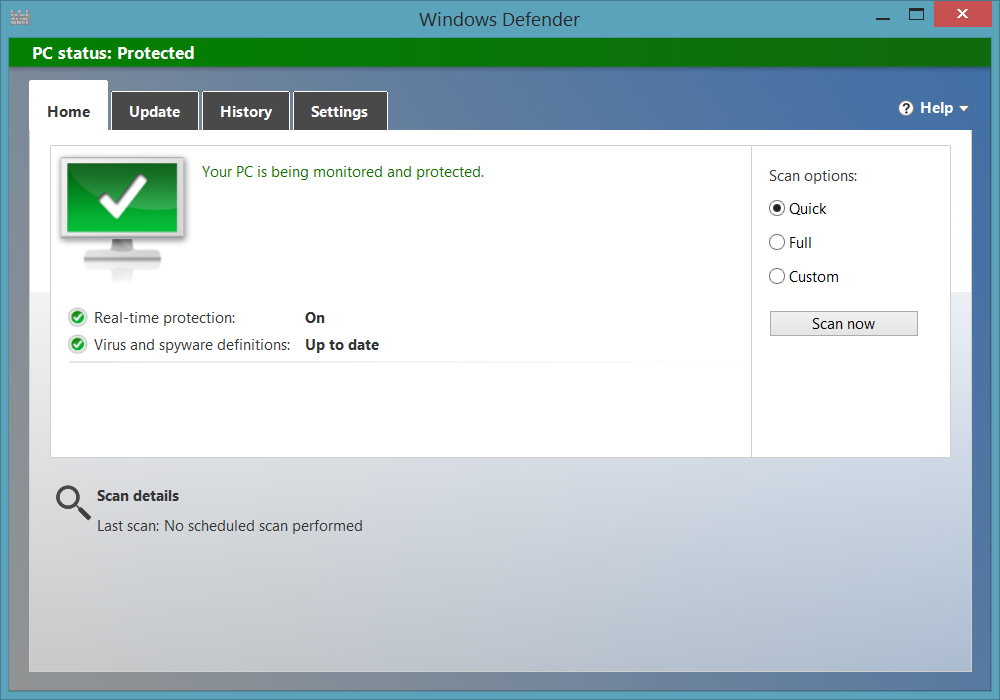
Windows Defender, the native antivirus program provided with Windows, will now include network-behavior monitoring. This will make it easier to detect the newer breed of malware that usually can’t be detected via traditional means, but rather through noticing anomalous activity on your company’s servers. Defender’s traditional virus detection capabilities remain, as well.
Windows Defender will likely appear just as it did in the first Windows 8 version, except perhaps with an additional setting for network monitoring in the finial release of 8.1 (click to enlarge).

Device Encryption embraces all Windows versions

Windows 8 RT is better known for what it lacks than for what it features, but one advantage it’s had over full-fledged Windows 8 is device encryption. This feature will now be available for all Windows 8.1 users. It will be enabled by default on most newer computers shipping with Windows 8.1, as well as supported devices that are upgraded to Windows 8.1 with a clean install.
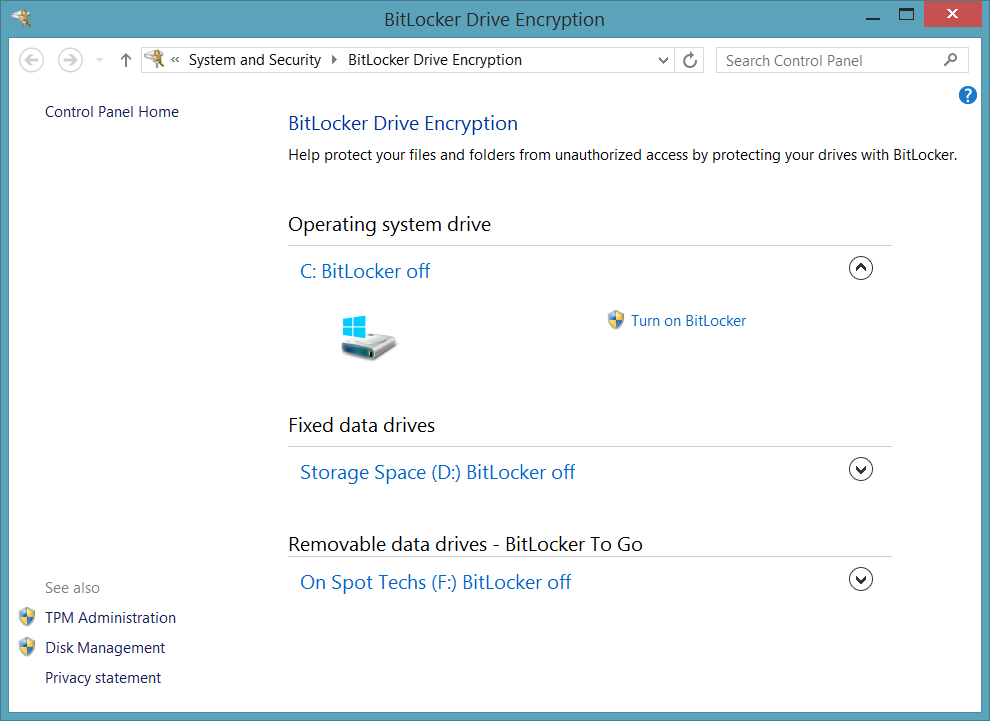
The encryption is basically a simplified form of the BitLocker encryption feature found in the Pro, Enterprise, and Ultimate editions of Windows 8 and previous versions of Windows. The full BitLocker feature is still available in the Pro and Enterprise editions of Windows 8.1, giving power users and corporations more management capabilities. For consumers who create and use a Microsoft account to log in to Windows 8.1 (or use a domain account on a corporate network), your entire PC or device will be encrypted.
The Preview release of Windows 8.1 includes just the BitLocker encryption settings; we should see new Device Encryption settings in the final releas (click to enlarge).

Fingerprint recognition supported

Windows 8.1 will enhance its biometric support, including native support for fingerprint authentication for laptops and devices with a fingerprint reader. Instead of typing in your password, for instance, a quick touch with your finger could log you in. This biometrics support is reportedly being added throughout and could be used for things like Windows login, User Account Control prompts, Windows Store access, and other features of Windows. And it’s likely that we’ll see more biometrics support from third-party software vendors as well.
This leaked screen shot of an internal build shows what the fingerprint enrollment process might look like (click to enlarge).

Assigned Access locks device use to a specific app

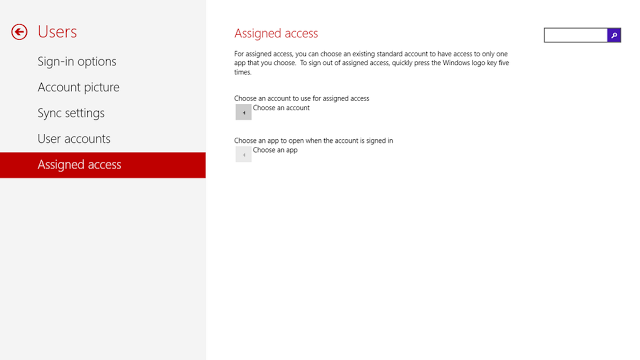
One brand-new feature introduced in Windows 8.1 is Assigned Access, which will be available in the Pro, Enterprise, and RT editions. It lets you lock down the computer or device for use with a specified app. This feature can help prevent users from accessing other apps or interfaces, making deliberate or accidental changes, and protecting the privacy of other information on the device. You can see how this would be useful in an educational environment—or even for a family with a Surface RT tablet for the kids. A public location, such as a kiosk, is another likely scenario for Assigned Access.
Although Microsoft hasn’t included the Assigned Access feature or settings in the Preview release, this leaked screen shot of an internal build shows what the settings might look like.

Remote Data Control can protect selected data

In Windows 8.1, Microsoft has enhanced the OS’s remote data control capabilities. Businesses will be able to mark certain data on employee computers and devices that should be kept encrypted, and that data can be wiped remotely if the device is lost or the employee leaves the company. This feature will be especially helpful as the BYOD trend grows (personal files on the device aren’t affected).
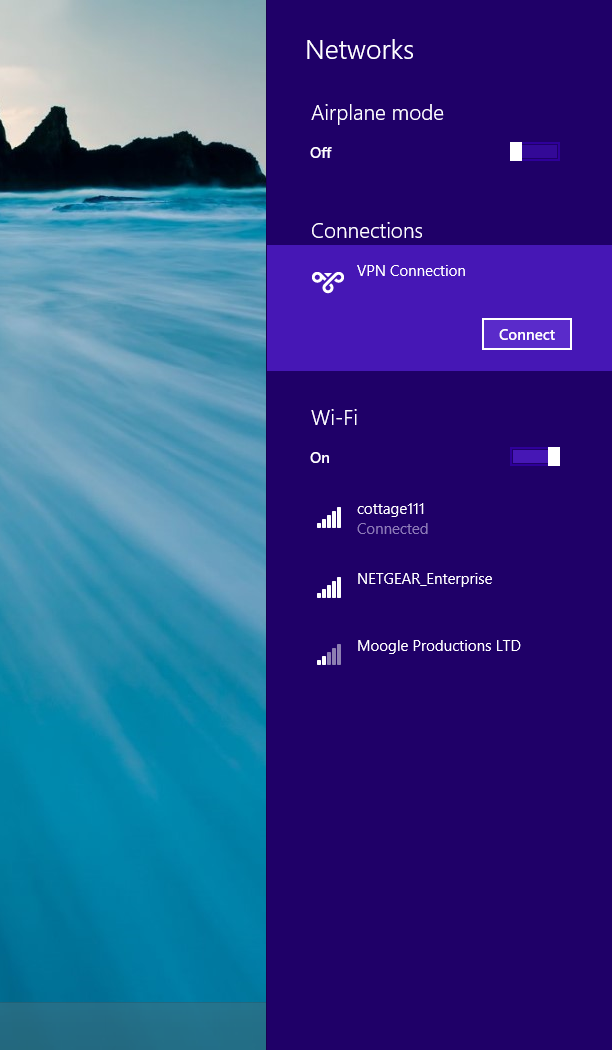
Manually connecting to VPNs via the Networks list remains the same (click to enlarge).

Windows 8.1 expands VPN support

Many of us use a Virtual Private Network (VPN) to connect securely to a remote network, such as a corporate office. According to Microsoft, Windows 8.1 will support a wider range of Virtual Private Network (VPN) clients, although details aren’t available yet. Additionally, Windows will allow third-party apps to initiate VPN connections automatically, possibly eliminating the need for you to start the connection manually all the time.

A better experience and better security

Windows 8.1 Preview has a lot to like, but the security enhancements show that Microsoft is keeping up with the times. The BYOD trend means that personal devices are handling corporate data, so remote wiping and other safeguards are vitally important. Everyone browses the Web, so anything that makes IE safer is a good idea. VPNs and device encryption help thwart sniffers and thieves. And best of all, most of these security features are already available in some form in Windows 8.1 Preview, so you can check them out now.

Microsoft: We don't give NSA direct access to email


Microsoft does not give the National Security Agency direct access to its customers’ email or instant messages, contrary to previous news reports, a company executive said.
News reports last week suggested that Microsoft has helped the NSA circumvent the company’s own encryption in order to conduct surveillance on email accounts through Outlook.com, but company General Counsel Brad Smith said Tuesday that’s not true.

“We do not provide any government with direct access to emails or instant messages,” Smith wrote in a blog post. “Full stop.”

The company does not help government agencies circumvent its encryption, he added. “To be clear, we do not provide any government with the ability to break the encryption, nor do we provide the government with the encryption keys,” he wrote. “When we are legally obligated to comply with [government] demands, we pull the specified content from our servers where it sits in an unencrypted state, and then we provide it to the government agency.”

Microsoft on Tuesday asked U.S. Attorney General Eric Holder to permit Microsoft and other communications providers to share “more complete information” about how they handle national security requests for customer information, Smith added.
“We believe the U.S. Constitution guarantees our freedom to share more information with the public, yet the government is stopping us,” he said. The U.S. government has not responded to a June 19 request Microsoft made to publish the number of national security requests it receives, and the company hopes Holder will step in, Smith said.

Microsoft provides government access to data stored in its SkyDrive service and to Skype calls when presented with a legal order to do so, such as a search warrant or national security letter, Smith said. If asked for customer data in enterprise email or document storage, Microsoft attempts to redirect the requesting government agency back to the customer, he said, “and we notify the customer unless we are legally prohibited from doing so.”

Microsoft has never provided any government with customer data from any business or government customers for national security purposes, he said. In 2012, the company complied with four law enforcement requests related to business or government customers, he added.

Tuesday, July 16, 2013

What is Thunderclap?


If a tweet falls in the forest...
 
Social media is an easy way to say something, but it’s a difficult way to be heard. Thunderclap is the first-ever crowdspeaking platform that helps people be heard by saying something together. It allows a single message to be mass-shared, flash mob-style, so it rises above the noise of your social networks. By boosting the signal at the same time, Thunderclap helps a single person create action and change like never before.
 
You don't need a huge following for a successful Thunderclap.
 
A user with 200 Facebook friends could amplify her message better than someone with 3,000 friends. It all depends on your cause's voice and shareability—and how much your friends are engaged. Thunderclap has already reached millions of people. Check out some of the successful projects on our homepage!
 
The tipping point

The beauty of Thunderclap is that it sets the goalposts: one message, one number, one date. It's a common threshold you and your supporters work toward together. It's a tangible way to measure awareness.

To Join Thunderclap now Go to below Link
http://thndr.it/10MO1qX

Saturday, July 6, 2013

AMD Unveils 5.0 GHz FX Processor

AMD FX Logo
The rumors have been going around the web for some time now, but today AMD officially unveiled two new FX-series processors with clocks up to 5.0 Ghz out of the box. The new parts are based on the ubiquitous Piledriver x86 cores powering the latest generation of FX processors “Vishera” as well as FM2 socket A-Series APUs, and will be referred to as FX 9000-series CPUs. So far, two SKUs are planned to be released; the top dog being FX-9590 with eight cores running at a 5 GHz Max Turbo clock, followed by FX-9370 with a 4.7 GHz Max Turbo. AMD does not state at this time what the base clocks will be. The two new processors will come with unlocked multiplier for easy overclocking, as with all FX-Series models.
The parts will first be made available to system integrators and there is no word on when, or if, they will reach the retail market. Furthermore, and although AMD did not detail the power aspect of these new parts, rumors are they will come with a TDP of more than 200 W.
Editor’s note: We haven’t been able to confirm with AMD, but the current word around the rumor mill is that these may not even make it to channel and will be limited to boutique PC builders only

Friday, June 7, 2013

Lenovo opens first manufacturing facility in US

Also Read : Intel unveils fourth generation Intel Core processors

Lenovo_Conv-635.JPG
Three business reasons quicker, loser and custom prompted computer maker Lenovo to open its first US manufacturing operation in North Carolina instead of low-cost foreign locations like Mexico or China, its North American president said.

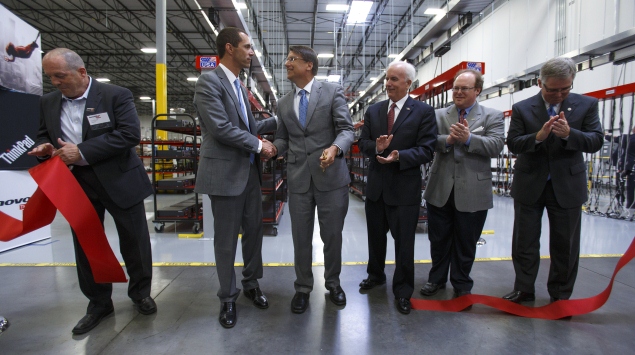
Lenovo expects to finish hiring 115 production workers by the end of June at the manufacturing operation that opened in January inside an existing distribution center in Whitsett. The company on Wednesday celebrated the US production line small compared to its sites elsewhere.

"The reason that we're doing this and have made this decision is because we believe it can bring us some advantages in this marketplace," Lenovo North America President Jay Parker said in an interview.

Lenovo, the world's second largest PC maker behind Hewlett-Packard, is based in China but has executive headquarters in Morrisville, where about 2,000 work. The company bought IBM's PC business there in 2005.

Lenovo's site along Interstate 85, a major East Coast transportation corridor, is about 40 miles (65 kilometers) from the personal computer factory that Dell opened in 2005. The plant's workforce peaked at 1,400 employees but it closed in 2010 after Dell recognized customers were turning away from desktop computers for more mobile devices.

The addition of production to an existing Lenovo distribution and returns center has been called an example of onshoring or reshoring a move by manufacturers to reverse the decades-long trend of transferring production to low-cost countries overseas. Parker made it clear that Lenovo's North Carolina operation fills some important niches.

The Whitsett site's output of ThinkPad laptops, commercial desktop computers, and - by end of 2013 tablets and servers is expected to ramp up to several hundred thousand units a year, Parker said. The rest of the approximately 7 million Lenovo devices sold each year in the US and Canada would continue to be shipped from factories in Mexico, China and elsewhere, he said.

US production means faster product delivery for customers that demand it, Parker said. The new factory also allows Lenovo to wait until late in the production cycle before customizing devices, for example with cover etchings or tags that help companies and universities keep track of their property, he said. Governments and some other customers want or require products they buy to be built in the USA, he said.

"Those make a business case for us to put this facility here," Parker said. "The fact is, the costs are still higher (than overseas). It's an investment for us. Essentially we've decided that there's a business case that can be closed because we have a competitive advantage here."

The Lenovo plant represents a larger fact about how US manufacturing competes against lower-wage countries, said Terri Helmlinger Ratcliff, executive director of North Carolina State University's Industrial Extension Service, which connects manufacturers with the school's resources. Factories in the US must turn "from mass manufacturing of the same product to mass customization," she said.

That means fewer people and more automation, Helmlinger Ratcliff said, "which is driving us toward a workforce that looks very different."

Lenovo said in May 2013, its sales of desktop and laptop PCs both declined 2 percent in the latest quarter, but profit rose 90 percent as sales of smartphones and mobile computing technology expanded.

The company sees continuing growth in North America on top of an already strong presence in Asia and Europe, Parker said.
For the latest technology news and reviews, like us on Facebook 

Tuesday, June 7, 2011

Why I'm glad Computer Scientists invented the internet -

- and not politicians. (No offense, Al).

Apparently after Sarah Palin's recent gaffe claiming a revisionist American history regarding Paul Revere's ride (and then doubling down about it), inspired a group of her supporters to rewrite the Revere wikipedia page to support her statements. As it happens, an interview with Sarah Palin does not exactly constitute a valid source, so Wikipedia said, "uh, no," and that was that.

Not that Wikipedia was exactly a bastion of valid historical data to begin with (and people are easily fooled by citation-looking-things), but this was a pretty weird thing for Palin-fans to do in my not particularly humble opinion. (Twitter is much better for spreading misinformation, doncha know?)

Anyway - Pedantic Wikipedia editors: 1, Wignuts: 0.

Also:

Image description: Paul Revere holds his head in his hand
whilst holding a teapot.

Credit: From Charles Johnson, from Boing Boing.

Monday, December 13, 2010

The Wikileaks Drama Continues

In recent news of this drama-riffic story, hackers have been attacking any organization or individual who has been deemed "unsupportive" of Wikileaks. This includes Swedish prosecutors, MasterCard, Visa, PayPal, and the Swiss Postal system. Largely these attacks have been ineffectual and meaningless, or, as one writer put it, "More like a cybermob than cyberwarfare".

As for the 1337 hackers, I have to say I'm not really following the call to arms. Because the scorecard as I see it is:
  • Someone stole raw data that was not theirs to steal. (Which, as the NY Times put it, "The Pentagon Papers this is not.")
  • These data were leaked it to Julian Assange.
  • Instead of caring about, well, anything, Assange acts like a megalomaniac drama queen pretending to be a journalist. So he dumps this raw data out on to the Internet. He encrypts some of it. Some of it he doesn't.
  • The guvvies try to get their data back, but, well, we know how that worked out
  • Assange carries on the drama by saying, "boy-o-boy, watch out guvvies, touch me and I release the key to my insurance file!!111!!" 
  • And all the bozos on Slashdot and Digg and elsewhere keep up their battle cry of this ludicrous Save Assange! Hack the Planet! Swiper No Swiping! 
This whole thing is like a teenage romance novel, except without the vampires to keep me entertained.

Frankly, I wish the black hats would actually come together to do some useful vigilanteism, like, say, help prevent child trafficking, or use computing tools to help find missing children. Assange just isn't worth it.

Tuesday, November 23, 2010

TSA Awareness FAIL

First there were the women who had their vaginas groped. (Including a rape survivor). Then there was the woman who had breast cancer who was rudely asked to remove her prosthetic breast. And now, there is a person who had bladder cancer (and an urostomy bag) who was treated rudely when he requested privacy pat-down, would not be listened to when he tried to explain his condition and how his urostomy bag worked ("don't break the seal"), had to sit for hours in his own urine because TSA was too stupid to follow directions.

I am outraged. I cannot tell you how outraged I am. This is stupid, useless, and ridiculous. TSA screeners, get a freaking clue and start treating people as HUMAN BEINGS, not terrorists. Think RESPECT not SUSPECT.

PS: Also, at re-education camp, I highly suggest you enroll in a class on probability and statistics.  You need some serious help with sampling.

Thursday, October 7, 2010

Honeybee Mystery Solved!

This article made me really happy. In case you weren't aware, since 2006 honeybees have been dying in droves, and no one knew why. All I could figure was that some seriously weird X-Files stuff was going on. But it turned out it was a virus-fungal double whammy. So, no aliens or mutant corn, just something pretty humdrum as far as nature is concerned.

Image by BrainPop
The nice part about the article was how the different scientists collaborated - all due to some clever networking:
"Human nature and bee nature were interconnected in how the puzzle pieces came together. Two brothers helped foster communication across disciplines. A chance meeting and a saved business card proved pivotal.
...
But it took a family connection — through David Wick, Charles’s brother — to really connect the dots. When colony collapse became news a few years ago, Mr. Wick, a tech entrepreneur who moved to Montana in the 1990s for the outdoor lifestyle, saw a television interview with Dr. Bromenshenk about bees.

Mr. Wick knew of his brother’s work in Maryland, and remembered meeting Dr. Bromenshenk at a business conference. A retained business card and a telephone call put the Army and the Bee Alert team buzzing around the same blossom.
I love that. (And not just because I'm a sucker for bad puns.). Person C connects Persons A and B, and fabulous science happens.