Short shameful confession: I had more fun than I can possibly tell you when I drew that last comic. Not only is it fun to create comics visually, but Comic Life makes these adorable sound effects when you resize images, delete them, increase the font sizes, etc.
My readers who are software designers - you seriously need to make more programs have cute sound effects. Can you imagine how much more joyful it would for people when they made a database entry it said, "YEAH!" every time they hit 'commit', or "Vooooooop!" when they resized a column in Excel? Help a girl out, put the FUN back in functional!
Anywho, on to today's post topic, which occurred to me in the wee hours of the morning.
For the longest time, I couldn't understand why movie playing software had a "repeat" button. These days I barely have the attention span or time to sit through one movie, let alone the same movie several times. I thought, well, maybe it's for those always-on televisions in places like hospital waiting areas and electronics stores. The people that work there, forced to watch this same horrible movie repeatedly, are not going to want to get up every time the credits roll. Especially if it's playing on forty TVs.
But, still, that can't possibly explain the design decision for a repeat button.
No, it had to be something else...
I remember the first time I saw the magic. It was winter, and my son was at a party with a dozen small children. They were indoors and literally bouncing off the walls. After about an hour, another parent said, "How about a movie?" and all the hyper kids screamed, "YEAH!". He put the movie in. Snap - just like that - immediate silence. Stillness. They were transfixed for hours.
With great power comes great responsibility, speaking of comics. But ParentWars be damned, bright-eyed children at 5am qualifies as the fairest use of television ever conceived.
Showing posts with label misc. Show all posts
Wednesday, May 25, 2011
Thursday, May 19, 2011
A Tryst by Typo
One of my email accounts is spelled in a very similar way to another person's, so sometimes I get their mail. We share a name. (Let's say it's "Ada").
A few weeks ago, I got a letter that looked something like this:
I got another email about a week later asking why I hadn't replied to the first one.
Yesterday I received one about coordinating a morning "meeting", and that although we'd said 9:30, Sam would be ok with starting at 8 to "get things moving". Then today he sent an email describing some rather graphic details of what transpired. (These details are left as an exercise to the reader.)
I can't tell you how amused I am by all this. I keep debating how I might reply to Sam, or how I can contact the other Dr. Ada. I wonder if she's a PhD or an MD, and I wonder if Sam is her student. Then I wonder if he is her student and they are having a tryst, how on earth does she tolerate his egregious grammar and spelling errors?
In any case, I'm glad they're not using .edu addresses to conduct their rendezvous, as I'm pretty sure that's discoverable.
A few weeks ago, I got a letter that looked something like this:
Hey Dr. Ada,
I know its prolly not appropriate to be writing this, but I cant wait to see u nekkid, covered in chocolate.
Happy Easter,My first thought was, "OMG! Did I have a student named Sam? What the heck?!?" Then I realized I was not the intended recipient and ignored it.
Sam
I got another email about a week later asking why I hadn't replied to the first one.
Yesterday I received one about coordinating a morning "meeting", and that although we'd said 9:30, Sam would be ok with starting at 8 to "get things moving". Then today he sent an email describing some rather graphic details of what transpired. (These details are left as an exercise to the reader.)
I can't tell you how amused I am by all this. I keep debating how I might reply to Sam, or how I can contact the other Dr. Ada. I wonder if she's a PhD or an MD, and I wonder if Sam is her student. Then I wonder if he is her student and they are having a tryst, how on earth does she tolerate his egregious grammar and spelling errors?
In any case, I'm glad they're not using .edu addresses to conduct their rendezvous, as I'm pretty sure that's discoverable.
Thursday, April 28, 2011
Business travel for newbies
A new graduate student recently attended their first conference, and was a bit confused as to what "counted" when filling out their expense report. So I thought I'd make a post about this topic in case anyone else was new to this.
Every institution is different, but I'm generally of the opinion that from the minute your leave your house to the minute you get back you are on the clock, and everything "counts". (Assuming you're not also taking personal travel during the business trip, but that's an entirely different post).
There are some things that will almost always be reimbursed - taxis, busses, trains, airplanes, rental cars, hotels, conference registration. Some things are usually reimbursed - internet usage, business-related telephone calls, meals. Some things are usually not reimbursed - purchasing toiletries, souvenirs, entertainment, etc.
Sometimes something you think might not be reimbursed is, like room service or dry cleaning, and sometimes something you think will be reimbursed won't (e.g., upgrading from a $45/day car rental to a $46/day car rental of a larger size. I really wish I was joking on this one.)
Some US-based institutions grant employees "per diem" for non-lodging related expenses. This is a fixed sum based on location, and is meant to include food and "incidentals". It is given as a lump sum to the employee, pro-rated for the entire trip. If you're able to eat cheaply, you often end up making money on your business trips instead of just breaking even, which is pretty nice.
Other institutions want you to save all of your receipts, and itemize every expense. If you go out to dinner at a conference with 34 people it can get a bit tricky, some people get around this by asking for separate checks or getting multiple copies of the big check circling what they had. One colleague takes photographs with their phone to save time, which I think is pretty clever.
In any case, it's always worth saving all receipts and trying for reimbursement. There's no reason to be shy, or sweat over an expense you're not sure is reimbursable. Usually the worse that will happen is you'll be told "no".
Oh, one more thing. When you're on business travel, don't feel like you are required to share a room, stay in a roach-infested motel, or sleep on someone's couch. By the same token, don't stay at the Westin when there's a perfectly decent modestly priced place across the street. Be reasonable, and the people paying for your trip hopefully will be too.
Wednesday, April 20, 2011
Conference, I thee wed
Recently I was joining a professional organization outside my discipline. I went to the website to register, and was asked:
- My marital status
- The name of my spouse
- My anniversary dateAnd this isn't some skeezy society that is secretly marketing its members, this is a valid, bone fide organization!
I wonder if they will send me free coupons to their journal on my birthday, and a special society mug on my anniversary. That'd be great. IEEE and ACM definitely need to get in on this action.
Wednesday, March 23, 2011
Agent's Smith Registry
I have just discovered the joy that is comixed.com. This one is probably my favorite so far:
While we're talking about The Matrix, I just stumbled across this video of a recreation of a scene from the film in Lego. I somehow missed it the first time around when it came out in 2009, so in case you did too here it is:
* From now on I'm going to try to make my captions more accessible to readers who are blind and/or visually impaired. Please call me on it if I forget!
While we're talking about The Matrix, I just stumbled across this video of a recreation of a scene from the film in Lego. I somehow missed it the first time around when it came out in 2009, so in case you did too here it is:
You can also watch the side-by-side with the original film. It's amazing.
* From now on I'm going to try to make my captions more accessible to readers who are blind and/or visually impaired. Please call me on it if I forget!
Tuesday, March 15, 2011
Channeling Ledisi
I've always been a big fan of Motown, so I was really excited to learn that for Black History Month the White House hosted a special Motown concert, broadcast by PBS last week. They had the greats - Smoky Robinson, Stevie Wonder, and some newer musicians who are incredibly talented, like Amber Riley and John Legend.
If you like Motown, check it out, absolutely worth an hour of your time. But the thing I want to highlight for this post is the difference in stage presence between two of the performers.
Now, keep in mind, this is a small venue, with chandeliers and pictures of George Washington in the background, an unusual repertoire for some of these artists (poor Seal), and a very lackluster sound engineer. Oh, and - performing in front of the Obamas. It's enough to make anyone nervous, even the big stars.
In the video, go to Chapter 9 (around 29:05), and watch and listen to a minute or two of Natasha Bedingfield's performance.
Now, skip back to Chapter 5 (around 15:14) and watch and listen to some of Ledisi's performance.
Spot a difference?
Ledisi is so relaxed in the music and the song and herself. She's not in any rush, she's not trying to be something she's not. She's just there, singing. As a result, I think the audience feels relaxed, and in sync with her.
I think this is something to aim for when interacting with people - when giving talks, interviewing for jobs, networking at conferences, teaching, whatever. When you're comfortable and at ease with yourself it shines through to others. The people who try too hard, you can spot them a mile away.
So my personal aim for the spring is to channel Ledisi. Because she's just made of awesome.
| The Supremes |
If you like Motown, check it out, absolutely worth an hour of your time. But the thing I want to highlight for this post is the difference in stage presence between two of the performers.
Now, keep in mind, this is a small venue, with chandeliers and pictures of George Washington in the background, an unusual repertoire for some of these artists (poor Seal), and a very lackluster sound engineer. Oh, and - performing in front of the Obamas. It's enough to make anyone nervous, even the big stars.
In the video, go to Chapter 9 (around 29:05), and watch and listen to a minute or two of Natasha Bedingfield's performance.
Now, skip back to Chapter 5 (around 15:14) and watch and listen to some of Ledisi's performance.
Spot a difference?
Ledisi is so relaxed in the music and the song and herself. She's not in any rush, she's not trying to be something she's not. She's just there, singing. As a result, I think the audience feels relaxed, and in sync with her.
I think this is something to aim for when interacting with people - when giving talks, interviewing for jobs, networking at conferences, teaching, whatever. When you're comfortable and at ease with yourself it shines through to others. The people who try too hard, you can spot them a mile away.
So my personal aim for the spring is to channel Ledisi. Because she's just made of awesome.
Friday, March 11, 2011
The Social Network
Due to circumstances beyond my control (a long plane ride), I watched "The Social Network". I didn't really want to watch it, but also sort of did, kind of like a train wreck. I also wanted to see sudo*-Matt Welsh's cameo teaching Operating Systems.
I was pleased that Hollywood got some of the technobabble correct (apache with a SQL backend), and I loved that the closeup of Mark's laptop showed it running *nix. I also thought it was cute they re-branded the iBook laptop as "Book".
However, I was greatly displeased with how the film portrayed women. By my count, there was only one female character who was not: a flake, a flirt, a drunk, a girlfriend, or crazy - and she was a lawyer with hardly any personality depth. Why were there no female engineers, or CS majors? Or, heck, I'd even take an Art History major. Just somebody with some brains to accompany the legs.
I was also displeased with how Mark Zuckerberg was portrayed. I don't know the real Mark, but the director seemed really dedicated to employing the geek-with-zero-social-interaction-skills trope. Couldn't the actor have smiled occasionally? Been somewhat friendly now and then?
So, Hollywood, your scorecard is: B+ for suspending my geek disbelief, but an F for perpetuating stereotypes.
(*) Pun intended!
I was pleased that Hollywood got some of the technobabble correct (apache with a SQL backend), and I loved that the closeup of Mark's laptop showed it running *nix. I also thought it was cute they re-branded the iBook laptop as "Book".
However, I was greatly displeased with how the film portrayed women. By my count, there was only one female character who was not: a flake, a flirt, a drunk, a girlfriend, or crazy - and she was a lawyer with hardly any personality depth. Why were there no female engineers, or CS majors? Or, heck, I'd even take an Art History major. Just somebody with some brains to accompany the legs.
I was also displeased with how Mark Zuckerberg was portrayed. I don't know the real Mark, but the director seemed really dedicated to employing the geek-with-zero-social-interaction-skills trope. Couldn't the actor have smiled occasionally? Been somewhat friendly now and then?
So, Hollywood, your scorecard is: B+ for suspending my geek disbelief, but an F for perpetuating stereotypes.
(*) Pun intended!
Friday, February 18, 2011
Prescient spam
I work in area X. I recently wrote a paper on area X_1, and submitted it to a conference. It was rejected. So I revised it and resubmitted it to a more topic-relevant conference, and it is currently under review. There is absolutely nothing in the public sphere indicating that I have done work in field X_1 that I am aware of.
Today I got a spammy email from one of those shady journals that spams anyone who ever published something in IEEE Xplore or the ACM Digital Library, saying:
The funny thing is, this journal never spams me on areas of X_2, X_3, or X_4 (none of which I work in, but they publish in), so this is fairly deliberate spam.
So how did they know about my new professional foray? Clearly this is evidence that they are psychic. Or one of my reviewers blabbed. I'd say it's a 50/50 probability of either.
Today I got a spammy email from one of those shady journals that spams anyone who ever published something in IEEE Xplore or the ACM Digital Library, saying:
Dear Dr. FCS, // Not a bad start, calling me "Dr." instead of "Ms." (or "Mr.")
Our Journal of X has a special issue coming up on X_1. Given your expertise in this area we would like to invite you to submit something.
Sincerely,
Editor in Chief of Shady JournalMostly I am fascinated that they somehow know I am working in area X_1. Looking at the editorial board of the shady journal and the PC of the two conferences this paper has been seen by, I see no obvious overlap.
The funny thing is, this journal never spams me on areas of X_2, X_3, or X_4 (none of which I work in, but they publish in), so this is fairly deliberate spam.
So how did they know about my new professional foray? Clearly this is evidence that they are psychic. Or one of my reviewers blabbed. I'd say it's a 50/50 probability of either.
Monday, January 24, 2011
Fashion Tips, Part II
As promised, here are some specific professional dress tips for women. I am in no way a fashionista - I am a computer scientist - but I will pass along things that have worked for me. I should also note that I am all about low-maintenance everything - clothes, hair, shoes, etc. I want to optimize sleeping, research, and goofing off - not waking up three hours early to put on makeup and straighten my hair. (That'll be the day!). And I hate ironing.
The ultimate goal for professional dress for women (of all levels - from casual -> business casual -> formal attire) is to look classy without looking trashy. Most modern clothing designers make this damn near impossible, as they seem to think all we women ever want to do is to pick up guys at bars.
What's worked for me is to buy a few nice, key articles of clothing that are robust and hold up to being washed frequently. If I find an article of clothing that fits exceptionally well and looks well-made, I sometimes will buy several. (Because you can bet anything if you go back in a few months it won't be there!). Sometimes you spend a little more to get something well made, but it (usually) lasts longer than something cheapy, so it's worth it.
I've interleaved a few tips about dressing down outfits, since a few of you asked.
Stores
There are a few clothing stores that I always manage to find something at, and if you manage to get sales you can often swing some wonderful deals. These stores include:
- Ann Taylor / Loft
- Chico
- JC Penny
- Sears
- Macy's
- Kohl's
- *sometimes* : Banana Republic / Gap / NY&Company/H&M/Target. Sometimes clothing from these places falls apart after two washes, so it's not always worth it, but sometimes you get lucky and have a great find.
Pants
I like to buy lined pants, because they can make one look professional without looking trashy or dowdy. Typically my favorite place to find these have been Ann Taylor.
In general my rule of thumb for pants is if another person can tell when you're flexing your gluteus maximus, they're probably too tight for a professional context.
Sometimes you need to spend a bit of money to get pants altered. If the pants are well-made and will last you a few years, this is money well-spent. I have two pairs of pants I wear both as part of a suit and also solo for less dressy occasions. I paid more to have them altered than I did the pants, but they fit exceptionally well and look good, so it was worth it.
Shirts
As I said, I'm all about low maintenance and comfortable, so most of the shirts I like to wear are made of fabrics that don't wrinkle, like lycra, and cotton knits. Chico sells some great, thick lycra shirts that are nice and can help conceal pudge if you have any. Their sizes run big, though, so if you have a more petite figure you may need to take the shirts in a bit.
I occasionally wear button-down shirts, but in my experience they are more trouble than they're worth, because you inevitably have to iron them. Some friends had good luck finding iron-free shirts at places like Brooks Brothers, but when I went there I found their shirts looked ridiculous on me. They felt like they were designed for men.
Sweaters are a great way to dress down fancier pants, if you don't want to look too formal but don't want to wear jeans. I like cotton turtleneck sweaters, or sometimes V-neck sweaters with a tank-top / cami on underneath them. Gap and H&M have served me well here - I've purchased a few thick cotton sweaters there that have lasted me for years.
Just like pants, it's important to get shirts that fit well, that are not too tight and not too low-cut. I have owned a few shirts over the years that were too tight for professional contexts, so I fixed them with a cardigan, jacket, or a pashmina.
Skirts and Dresses
I have no tips about skirts and dresses, as professional ones always seem to look ridiculous on me. And more importantly, panty hose and tights are far too high maintenance. One run and you're stressing out over nylons instead of, say, your conference talk. Not fun.
Jackets
Blazers are a great way to dress up jeans, so you can find a happy medium. I really like darker colors, such as black and dark brown. Definitely solids, though a light pinstripe is ok I suppose. I think corduroy blazers are great for men and women, regardless of whether they are in style or not - they just look nice.
Cardigans / open sweaters are a nice way to dress down fancier pants if you're worried they look to dressy. If you get one that is fitted, it will look professional without looking frumpy. (Here are some examples). Though I'll tell you, at my last job I always wore big frumpy sweaters because some of those machine rooms were cold!
Shoes
The most important thing about shoes is that you are comfortable. Again, shoe designers are seriously out to get us. I can't tell you how many shoe stores I visited over the holidays with my mother-in-law, and we both basically decided the shoe designers are Satan.
A few brands that maybe/sort of / sometimes feel comfortable are: The Walking Company, Aerosole, Naturalizer. Sometimes you can find comfortable casual-dressy shoes at L.L. Bean, REI, and EMS. People that design shoes for hikers often have enough clue to design comfortable shoes that can be worn by white-collar office-warriors.
The only other rule for professional shoes is don't wear: furry boots, hiking boots, open-toed boots, flip-flops, or sneakers. Otherwise wear whatever you like.
Bags
Try to avoid using a backpack if at all possible. I'm aware that it's better for your back, especially if you are lugging around many things from place to place (laptop, papers, books, etc). Instead, there are nice wheely professional bags for women you can get. Sometimes people look at you funny wheeling something across an office building or campus, but you can just smile and say, "Bad back", and they'll leave you alone.
But if the wheely bag isn't appropriate for your context and you want to save your back (can't blame you), try to get a classy looking backpack. For example, select a bag from here. Several of these are perfectly reasonable to use in professional contexts.
Otherwise, if your travel gear is lightweight, really any shoulder bag will do. Just keep it simple and low-key. No bling.
Jewelery
Really wear whatever you like, just be sure it is tasteful and nondescript. Also be aware than anything with any sort of symbol or emblem on it will likely spurn discussion, which may or may not be a good thing.
Coats
I think wool coats with straight lines and nothing hanging off them are the most professional looking. I knew someone who always wore a fur coat to work and it always looked very strange to me. Sportsy jackets tend to look odd if you have dress pants on. (Or at least they do to me).
And that's all she wrote. I will try to do a post for the men sometime within the next few weeks.
The ultimate goal for professional dress for women (of all levels - from casual -> business casual -> formal attire) is to look classy without looking trashy. Most modern clothing designers make this damn near impossible, as they seem to think all we women ever want to do is to pick up guys at bars.
What's worked for me is to buy a few nice, key articles of clothing that are robust and hold up to being washed frequently. If I find an article of clothing that fits exceptionally well and looks well-made, I sometimes will buy several. (Because you can bet anything if you go back in a few months it won't be there!). Sometimes you spend a little more to get something well made, but it (usually) lasts longer than something cheapy, so it's worth it.
I've interleaved a few tips about dressing down outfits, since a few of you asked.
Stores
There are a few clothing stores that I always manage to find something at, and if you manage to get sales you can often swing some wonderful deals. These stores include:
- Ann Taylor / Loft
- Chico
- JC Penny
- Sears
- Macy's
- Kohl's
- *sometimes* : Banana Republic / Gap / NY&Company/H&M/Target. Sometimes clothing from these places falls apart after two washes, so it's not always worth it, but sometimes you get lucky and have a great find.
Pants
I like to buy lined pants, because they can make one look professional without looking trashy or dowdy. Typically my favorite place to find these have been Ann Taylor.
In general my rule of thumb for pants is if another person can tell when you're flexing your gluteus maximus, they're probably too tight for a professional context.
Sometimes you need to spend a bit of money to get pants altered. If the pants are well-made and will last you a few years, this is money well-spent. I have two pairs of pants I wear both as part of a suit and also solo for less dressy occasions. I paid more to have them altered than I did the pants, but they fit exceptionally well and look good, so it was worth it.
Shirts
As I said, I'm all about low maintenance and comfortable, so most of the shirts I like to wear are made of fabrics that don't wrinkle, like lycra, and cotton knits. Chico sells some great, thick lycra shirts that are nice and can help conceal pudge if you have any. Their sizes run big, though, so if you have a more petite figure you may need to take the shirts in a bit.
I occasionally wear button-down shirts, but in my experience they are more trouble than they're worth, because you inevitably have to iron them. Some friends had good luck finding iron-free shirts at places like Brooks Brothers, but when I went there I found their shirts looked ridiculous on me. They felt like they were designed for men.
Sweaters are a great way to dress down fancier pants, if you don't want to look too formal but don't want to wear jeans. I like cotton turtleneck sweaters, or sometimes V-neck sweaters with a tank-top / cami on underneath them. Gap and H&M have served me well here - I've purchased a few thick cotton sweaters there that have lasted me for years.
Just like pants, it's important to get shirts that fit well, that are not too tight and not too low-cut. I have owned a few shirts over the years that were too tight for professional contexts, so I fixed them with a cardigan, jacket, or a pashmina.
Skirts and Dresses
I have no tips about skirts and dresses, as professional ones always seem to look ridiculous on me. And more importantly, panty hose and tights are far too high maintenance. One run and you're stressing out over nylons instead of, say, your conference talk. Not fun.
Jackets
Blazers are a great way to dress up jeans, so you can find a happy medium. I really like darker colors, such as black and dark brown. Definitely solids, though a light pinstripe is ok I suppose. I think corduroy blazers are great for men and women, regardless of whether they are in style or not - they just look nice.
Cardigans / open sweaters are a nice way to dress down fancier pants if you're worried they look to dressy. If you get one that is fitted, it will look professional without looking frumpy. (Here are some examples). Though I'll tell you, at my last job I always wore big frumpy sweaters because some of those machine rooms were cold!
Shoes
The most important thing about shoes is that you are comfortable. Again, shoe designers are seriously out to get us. I can't tell you how many shoe stores I visited over the holidays with my mother-in-law, and we both basically decided the shoe designers are Satan.
![]() |
| Shoe designers are satanic. |
A few brands that maybe/sort of / sometimes feel comfortable are: The Walking Company, Aerosole, Naturalizer. Sometimes you can find comfortable casual-dressy shoes at L.L. Bean, REI, and EMS. People that design shoes for hikers often have enough clue to design comfortable shoes that can be worn by white-collar office-warriors.
The only other rule for professional shoes is don't wear: furry boots, hiking boots, open-toed boots, flip-flops, or sneakers. Otherwise wear whatever you like.
Bags
Try to avoid using a backpack if at all possible. I'm aware that it's better for your back, especially if you are lugging around many things from place to place (laptop, papers, books, etc). Instead, there are nice wheely professional bags for women you can get. Sometimes people look at you funny wheeling something across an office building or campus, but you can just smile and say, "Bad back", and they'll leave you alone.
But if the wheely bag isn't appropriate for your context and you want to save your back (can't blame you), try to get a classy looking backpack. For example, select a bag from here. Several of these are perfectly reasonable to use in professional contexts.
Otherwise, if your travel gear is lightweight, really any shoulder bag will do. Just keep it simple and low-key. No bling.
Jewelery
Really wear whatever you like, just be sure it is tasteful and nondescript. Also be aware than anything with any sort of symbol or emblem on it will likely spurn discussion, which may or may not be a good thing.
Coats
I think wool coats with straight lines and nothing hanging off them are the most professional looking. I knew someone who always wore a fur coat to work and it always looked very strange to me. Sportsy jackets tend to look odd if you have dress pants on. (Or at least they do to me).
And that's all she wrote. I will try to do a post for the men sometime within the next few weeks.
Labels:
fitting-in,
jobs,
misc
Tuesday, January 4, 2011
Fashion Tips, Part I
I have recently been asked by several people to provide fashion suggestions for how to dress in professional settings. This is going to be a multipart essay - there is much to cover, and I'll make some more specific suggestions in future posts.
When in professional settings, it is good to dress professionally. Professional settings are defined as one's workplace, a conference, a job interview, giving a talk, etc.
However, defining "professional dress" can be tricky, and selecting the right attire for the organization can be tricky. I have worked for some organizations where professional attire means jeans and T-shirts. But usually professional dress falls somewhere between "business casual" (button-down shirts, nice looking pants, non-boots/non-sneakers*) and "formal" (suit, dress shoes).
The most important aspect of picking the appropriate level of professional attire is this: If you are inside the organization (i.e., employee), dress exactly as everyone else dresses, but if you are outside the organization (i.e., job candidate), dress one level up from what everyone else is wearing.
For example, if you work at an company where all the other employees wear a suit to work every day, you should wear a suit to work every day too. If they wear jeans, you wear jeans. It's all about blending in. You don't want to be noticed for your clothes - you want your clothes to be background noise to your brains.
Now there is one exception here - if you want to get promoted, or seen as able to fulfill a role "higher" than where you currently are, dress a level up. So if you want to be promoted to be a project leader, dress like all the project leaders do. If you want to be hired as a professor, don't dress like a graduate student at conferences. You want to be seen as a peer.
If you are outside an organization, for example, as a job candidate, you want to dress slightly better than what everyone in the organization wears. If they're all wearing jeans and sneakers, go one level up to "business casual". You probably don't want to wear a suit - especially if you're interviewing in Cupertino! If the employees wear a mix of business casual and jeans, then it's reasonable to wear a suit. Once you are employed you can figure out what to wear, but if you're an outsider trying to get in, dress slightly better than everyone.
If you don't know in advance what the standard attire is for the organization, err on the side of formal dress. People (including you!) take you more seriously when you are dressed up - there's peer-reviewed articles on this. :). I know some Computer Scientists who fiercely debate this, and argue that the scruffy person in flip flops and torn jeans is always the smartest person in the room, but take my word - don't be scruffy as an outsider.
(*) Dear CS Men: I beg of you, from the bottom of my heart, please do not wear those sinfully awful black sneakers (c.f. this). I don't know which uber-geek started this trend, but he was wrong to do it - they are a fashion abomination. Go buy yourself a nice pair of Rockports, or something from the Walking Company. If you absolutely must wear sneakers, get a pair of Converse or some trendy Adidas or something.
When in professional settings, it is good to dress professionally. Professional settings are defined as one's workplace, a conference, a job interview, giving a talk, etc.
However, defining "professional dress" can be tricky, and selecting the right attire for the organization can be tricky. I have worked for some organizations where professional attire means jeans and T-shirts. But usually professional dress falls somewhere between "business casual" (button-down shirts, nice looking pants, non-boots/non-sneakers*) and "formal" (suit, dress shoes).
The most important aspect of picking the appropriate level of professional attire is this: If you are inside the organization (i.e., employee), dress exactly as everyone else dresses, but if you are outside the organization (i.e., job candidate), dress one level up from what everyone else is wearing.
For example, if you work at an company where all the other employees wear a suit to work every day, you should wear a suit to work every day too. If they wear jeans, you wear jeans. It's all about blending in. You don't want to be noticed for your clothes - you want your clothes to be background noise to your brains.
Now there is one exception here - if you want to get promoted, or seen as able to fulfill a role "higher" than where you currently are, dress a level up. So if you want to be promoted to be a project leader, dress like all the project leaders do. If you want to be hired as a professor, don't dress like a graduate student at conferences. You want to be seen as a peer.
If you are outside an organization, for example, as a job candidate, you want to dress slightly better than what everyone in the organization wears. If they're all wearing jeans and sneakers, go one level up to "business casual". You probably don't want to wear a suit - especially if you're interviewing in Cupertino! If the employees wear a mix of business casual and jeans, then it's reasonable to wear a suit. Once you are employed you can figure out what to wear, but if you're an outsider trying to get in, dress slightly better than everyone.
If you don't know in advance what the standard attire is for the organization, err on the side of formal dress. People (including you!) take you more seriously when you are dressed up - there's peer-reviewed articles on this. :). I know some Computer Scientists who fiercely debate this, and argue that the scruffy person in flip flops and torn jeans is always the smartest person in the room, but take my word - don't be scruffy as an outsider.
(*) Dear CS Men: I beg of you, from the bottom of my heart, please do not wear those sinfully awful black sneakers (c.f. this). I don't know which uber-geek started this trend, but he was wrong to do it - they are a fashion abomination. Go buy yourself a nice pair of Rockports, or something from the Walking Company. If you absolutely must wear sneakers, get a pair of Converse or some trendy Adidas or something.
Labels:
fitting-in,
jobs,
misc
Wednesday, December 8, 2010
Digging to America
Under an avalanche of deadlines, travel, and other sundries I have been finding refuge in lightweight fiction. Last weekend at the library I borrowed Digging to America by Anne Tyler, which has at times had me rolling on the floor laughing. Other times it is less lightweight than I would have liked, but halfway through the book I'll still recommend it*.
Several passages in this novel have reminded me of anecdotes told by online friends Pika and GMP. There is one character, Maryam, has lived in the US for a very long time but due to her Iranian accent people still always ask her where she's from. For example, Maryam is at a party:
I find the "mommy wars" in this book exceptionally comical and well-penned, because all I can think is how I know people exactly like those characterized. Bitsy is often judgmental (and/or jealous) of her friend Ziba's parenting; her daughter Susan is a peer to Jin-Ho and was adopted on the same day.
(*) Though if this book turns into an awful ball of mush, I will rescind this remark.
Several passages in this novel have reminded me of anecdotes told by online friends Pika and GMP. There is one character, Maryam, has lived in the US for a very long time but due to her Iranian accent people still always ask her where she's from. For example, Maryam is at a party:
First he talked to Sami, on his other side... then it was Maryam's turn: How long had she been in this country? and did she like it?
Maryam hated being asked such questions, partly because she had answered them so many times before but also because she preferred to imagine (unreasonable though it was) that maybe she didn't always, instantly, come across as a foreigner. "Where are you from?" someone might just ask when she was priding herself on having navigated some particularly intricate and illogical piece of English. She longed to say, "From Baltimore. Why?" but lacked the nerve. Now she spoke so courteously that Lou could have no inkling how she felt. "I've been here thirty-nine years," she said, and "Yes, of course I love it."My favorite thing about this book is that the writer is extremely subtle and clever in how she brings up American cultural unawareness. There is one character, Bitsy, who tries so hard to get others to be "culturally sensitive" to her adopted daughter Jin-Ho that she is inadvertently over-the-top culturally insensitive to her Iranian friends. I find this character almost too embarrassing to read at times, but then I realize that's the entire point.
I find the "mommy wars" in this book exceptionally comical and well-penned, because all I can think is how I know people exactly like those characterized. Bitsy is often judgmental (and/or jealous) of her friend Ziba's parenting; her daughter Susan is a peer to Jin-Ho and was adopted on the same day.
A while ago, Sami and Ziba had gone away for the weekend and left Susan with Maryam. Bitsy was amazed when she heard about it. During her own brief absences - never longer than a couple hours, and only for unavoidable reasons such as doctor appointments - she used a person from Sitters Central, a woman certified in infant CPR. Anyhow, her mother was too frail to babysit and her in-laws had made it plain taht they had their own busy lives. But under no circumstances would she have considered leaving Jin-Ho overnight. She would have been frantic with worry! Children were so fragile. She realized that now. When you thought of all that could happen, the electrical sockets and the Venetian-blind cords and the salmonella chicken and the toxic furniture polish and the windpipe-sized morsels of food and the uncapped medicine bottles and the lethal two inches of bathtub water, it seemed miraculous that any child at all made it through to adulthood.Finally, for you academic types, I'll leave you a quote in the style of FSP:
Her family visited constantly. They showed up every weekend with platters of eggplant and jars of homemade yogurt. They hugged Sami to their chest and inquired after his studies. In Mr. Hakimi's opinion, European history was not the best choice of fields. "You propose to do what with this? To teach," he said. "You will become a professor, teaching students who'll become professors in turn and teach other students who will become professors also. It reminds me of those insects who only live a few days, only for the purpose of reproducing their species.:-)
(*) Though if this book turns into an awful ball of mush, I will rescind this remark.
Monday, August 9, 2010
Not your grandma's Tufte
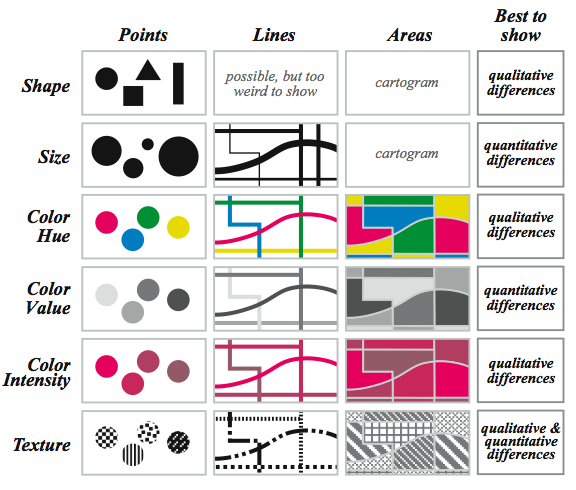
I really appreciate good data visualization because I think it's one of the best ways to communicate ideas. It's hard to know how to do it well, though, if you're not trained in design. For some reason I always stress over little details - fonts, colors, margins. But that happens when I cook, too, so maybe that's more a reflection of my personality than anything else.
I once met Ben Fry, who if you don't know is the co-creator of the Processing programming language, and (also) made a name for himself doing some gorgeous visualizations for SEED magazine. I had just seen a fantastic design of his, and asked him how he went about choosing its colors and fonts. He gave me some advice I still follow today: start with black helvetica and go from there.
As well as this advice has served me, I feel ready to move into serif fonts and at least dual-colored bar charts. So lately I've enjoyed reading the blog posts from Shawn Allen's Data Visualization Course. He starts with a history of data visualization (remember Florence Nightingale?) and builds up from there. It's excellent and I highly recommend checking it out.
| Image from Understanding Graphics |
I once met Ben Fry, who if you don't know is the co-creator of the Processing programming language, and (also) made a name for himself doing some gorgeous visualizations for SEED magazine. I had just seen a fantastic design of his, and asked him how he went about choosing its colors and fonts. He gave me some advice I still follow today: start with black helvetica and go from there.
As well as this advice has served me, I feel ready to move into serif fonts and at least dual-colored bar charts. So lately I've enjoyed reading the blog posts from Shawn Allen's Data Visualization Course. He starts with a history of data visualization (remember Florence Nightingale?) and builds up from there. It's excellent and I highly recommend checking it out.
Labels:
misc
Subscribe to:
Posts (Atom)